
The ERRC in Poland
07 November 2001
Eva Sobotka1
I conducted field research in Poland for the ERRC in the period June 13-July 1, 2001. Fact-finding included interviews with Romani individuals (around fifty), including activists from Romani organisations in Krakow - Nowa Huta (Marian Gil), Zabrze (Jan Mirga), Nowy Sacz (Miroszlaw Szczerba, Pawel Becherowski and Pawel Ondycz), Limanowa (Jan Ciereiu), Laskowa Gorna (Tadeusz Gabor), Tarnow (Adam Andrasz), Oswiecim (Roman Kwiatkowski) and Bialystok (Stanislaw Stankiewicz). In addition, I interviewed a number of public officials, as well as members of the wider civil sector. I also brought back extensive paper documentation from Poland. A brief overview of my findings follows:
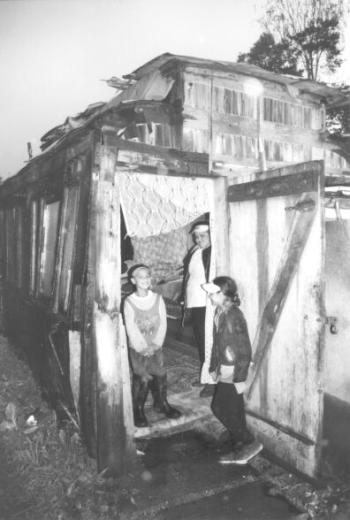 |
Roma in the Kroscenko settlement in Limanowa, southern Poland. Beginning on November 13, 1999, the settlement was reportedly subjected to repeated attacks by locals throwing Molotov cocktails. In this first attack, 19 persons, most of whom were children or elderly were rendered homeless when their house was burnt to the ground. Further firebomb attacks reportedly took place on September 17, 2000, and October 27, 2000, fortunately causing no injuries. Roma in the settlement alleged that they had been attacked by local non-Romani neighbours, and in a decision dated March 21, 2001, the prosecutor in the case stated that the perpetrators had likely been members of a "informal group with a Nazi orientation." He however closed the investigation without bringing charges on grounds that these persons had not been identified. Photo: ERRC |
I documented cases of state and non-state violence and discrimination in the provision of public services, education, employment, housing and health care. There is a lack of state protection in cases of human rights abuse of the Roma in Poland. Prejudice and stereotypical views apparently traverse all segments of society.
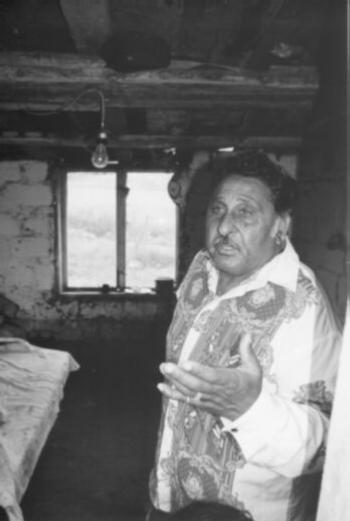 |
| Mr Jakob Mirga in the Romani settlement in Maszkowice, southern Poland. Mr Mirga regularly reports attacks by local non-Roma to the local authorities. He told the ERRC that non-Roma in his town are never prosecuted for anti-Romani crimes. Photo: ERRC |
Violence towards Roma is widespread throughout Poland. Perpetrators of anti-Romani violence are racist skinheads, police and local citizens. Skinhead violence is especially present in the Silesia region. I documented police violence in the Nowy Sacz area and violence by locals in a number of places, including the Malopolska Province, in the area around the town of Bialystok and in Warsaw. When Roma report that they have fallen victim to violent attack, in some cases I documented, police brought charges against Roma themselves. This results in a situation in which Roma refuse to report any violence at all. In one case I documented, the incident was reportedly treated as a "war between Gypsies and skinheads with which the police has nothing to do."
Roma are often effectively precluded from real access to justice. I documented, for example, the case of Ms T.A., who among other things was sentenced for crimes without enjoying any legal defence whatsoever. In another case, the police reportedly released the suspect in the beating of Ms K.K., a Romani woman who was three months pregnant at the time, allegedly after the mother of the suspect bribed police officers. Ms K.K. subsequently gave birth to a child with serious birth defects.
Romanian Roma who have been present in Poland in high numbers in the last decade, described cases in which children to which they had given birth were placed immediately in foster care, or placed with an ethnic Polish family as a result of - or with the assistance of - various bureaucratic tricks. In one reported case, the hospital apparently documented the name of the child incorrectly, then later claimed that the name of the child was different from that of the mother, and therefore this was not the real mother. The child was later put in the foster care institution and then later reportedly placed with a Polish family. Romanian Roma also reported skinhead attacks, police abuse, wrongful confiscation of property by the police and attacks by catholic church caretakers. Romanian Roma told me that there are fewer Romanian Roma living in Poland now than there were in the early 1990s, as many of the families that lived in Poland earlier have moved to Germany. For example in 1998, around 250 Romanian Roma reportedly lived in Krakow, but now there are only around 50 Romanian Roma living there.
 |
|
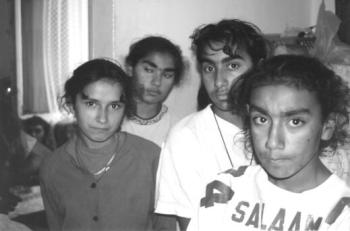
The children of Ms Aneta Mirga in the Nowa Huta ghetto in Krakow. Ms Mirga and her family live in a "building for non-payers of rent", although they state that they regularly pay rent. Non-Romani inhabitants of the building reportedly do not pay any rent. Seventeen people inhabit approximately twenty square metres. Heating is from a wood stove. At the time of the ERRC visit there was visible mold on the walls. |
In Poland, one frequently hears the argument from non-Roma, including from non-Roma in positions of authority, that, since the number of Roma living in Poland is low by regional standards (probably around 30,000), there is no "Romani problem" that human rights organisations, the government or the local administration should address. Another frequent contention about the situation is that there are no problems at all: No skinhead attacks, no police violence, etc. Also prevalent is the argument that, if Romani problems exist at all, these are only of a social character. When I pointed out that even rich Roma fall victim to attacks, there was no acknowledgement that a racial motive was possible in Poland. Denial is a serious problem in Poland: Publications denying the participation of Polish citizens in the Holocaust are sold in numerous copies on the street, in respected book shops and even in a state-owned kiosk network called "Ruch".
 |
 |
|
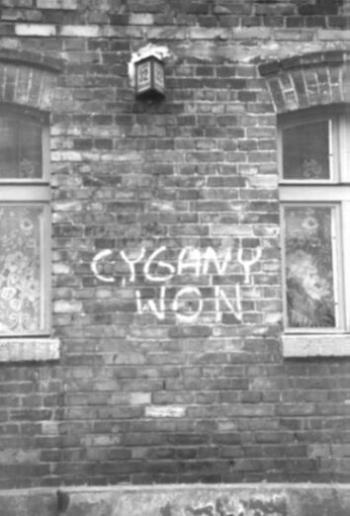
Graffiti in Zabrze in the Silesian region, southern Poland, stating "Gypsies, get out".
|
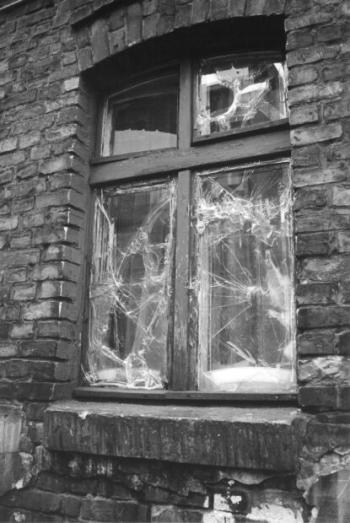
House inhabited by Roma in Zabrze, southern Poland. Roma in Zabrze reported being regularly attacked by local skinheads. The windows of the house were reportedly smashed by skinheads throwing cobblestones. |
Representatives of Romani organisations say that authorities frequently ignore them when they report human rights abuse of Roma. They report that authorities regard them as unrealistic in their expectations of the local authorities and police. One local mayor told me that the situation of Roma was a "problem of head", by which he meant, I discovered after pressing him on the issue, that Roma are stupid. When I interviewed the Ombudsman, he denied the existence of discrimination against Roma in Poland. Speaking for the record, he stated that Poland is a "discrimination-free country". He said that Poland has a "different concept of discrimination" than that prevalent in the "Anglo-Saxon world" and that those differences should stay in place.
According to representatives of the non-governmental organisation Never Again, some posts in the local administration are presently occupied by members of extremist right wing organisations. According to Never Again, anti-Romani sentiments are a part of the wider xenophobia and racist propaganda of extreme rightist organisations. Officials in the Catholic church - a very powerful institution in Poland - also reinforce antipathy towards Roma. Several priests have reportedly stated during mass that "God will never come to such a lost people as the Gypsies." In Krakow, it was reported to me that several church caretakers have chased Romanian Roma out of the church in order to prevent them from begging in the vicinity of the church.
State programmes on Roma are focused on the Malopolska Province. There were reportedly several local protests by non-Roma against this programme. As a result of some local government representatives have reportedly promised local non-Romani residents that the money will also be spent on them - whether from the Romani budget or not is unclear. I heard rumours, later confirmed by the deputy mayor of Nowy Sacz, that money from the programme for improving relations between Roma and the police was used for employing a co-ordinator with the police (a non-Romani woman) to monitor "Gypsy crime", and that the rest of the financial resources were used for improving the "technical situation of the police". As this was explained to me by the deputy mayor, this was effectively "to buy new arms for the police." This was presented to me as a great joke, with a hearty laugh by the deputy mayor, and was accompanied by several sexist comments at my expense. Members of the HFHR with whom I spoke expressed concern that the Maopolska programme will not be conducted properly, because the local administration will only receive money after applying for it, and many local administrators may avoid doing so. Also, the local authority is supposed to provide 40 percent of the budget for expenditures under the programme, and it is highly unlikely that local authorities will be willing to do that much for Roma.
Endnotes:
- Eva Sobotka is a political scientist affiliated with the Richardson Institute for Peace Research at Lancaster University, UK. She is also Director of the Roma School Success Program of the Budapest office of the non-governmental organisation American Friends Service Committee.