
Insufficient: Governmental programmes for Roma in Slovenia
15 August 2001
Tatjana Perić1
Only 2293 persons registered themselves as Romani in the most recent Slovene census, conducted in 1991.2 However, similar to trends all over Europe, most people working on Romani issues in Slovenia believe that the real number of Roma in the country is much higher. The estimates of local Romani leaders are that there might be as many as 10,000 Roma in Slovenia.3 If such estimates are true, Roma are among the most numerous national minorities in Slovenia, together with 8503ethnic Hungarians and3064 Italians. As for their distribution within the country, Roma live in high numbers in the Prekmurje region in north-eastern Slovenia, bordering Austria and Hungary, in the Dolenjska region in the southeast, bordering Croatia, and in cities and towns such as Maribor, Ljubljana and Velenje.
The terminology of "autochthonous" and "non-autochthonous" Roma, introduced and used by Slovene officials, deserves special attention. All official Roma-related discourse in Slovenia, and most legislation related to Roma, addresses only the so-called "autochthonous" Roma. The term is commonly held to refer to those Roma whose families have lived in Slovenia for more than a century, while the "non-autochthonous" Roma are understood to be those who arrived in Slovenia from the other Yugoslav republics, mostly Bosnia, Serbia and Kosovo, since large numbers of Roma and non-Roma began to move north and west, mainly for economic reasons, in the 1970s. However, the term has no legal definition, and in the course of ERRC research in Slovenia, it has proven impossible to determine on what basis officials designate a person "autochthonous" or "non-autochthonous".4 There are no written regulations stipulating how one might pass from the excluded "non-autochthonous" group to the more included "autochthonous" one. Indeed, the nomenclature treats Roma as inhabiting a quaint anthropological world where vague taxonomies apply, rather than as full citizens of a modern state.
In everyday life, the biggest problem facing "non-autochthonous" Roma as a group, as distinct from issues of concern to their "autochthonous" compatriots, is that most have been deprived of Slovene citizenship. In June 1991, after Slovenia declared independence from the former Yugoslavia and was recognised as a sovereign state, the new government adopted a new citizenship law, according to which only persons previously registered as citizens of both the former Republic of Slovenia and the Socialist Federal Republic of Yugoslavia (SFRY) could acquire citizenship of the new state5. Prior to 1991, however, most "non-autochthonous" Roma living in Slovenia had the citizenship of the former federation, but were not citizens of the then-Republic of Slovenia. The Ljubljana-based Helsinki Monitor of Slovenia estimates that over 130,000 non-Slovenes - including numerous Roma from other parts of Yugoslavia - were erased from the residence registers in early 1992, shortly following secession6. At a meeting with the ERRC, however, Mr Samo Drobež, an official from the Office for Administrative Internal Affairs of the Slovenian Ministry of Interior, insisted that nothing like an erasure from the state registers had taken place. Rather, those who were not registered as permanent residents of Slovenia were, according to Mr Drobež, transferred in 1992 to the register of foreigners7. This benign word game masks procedures which, in practice, deeply affected the lives of the 62,816 persons who, in 1992, possessed permanent residence, and the around 30,900 persons who, at that time, were in possession of temporary residence permits, according to the figures quoted by the Ministry. Apparently there were no regulations defining and setting criteria for this move, and according to Mr Drobež, "there does not have to be a rule for every procedure.8"
Under pressure because of reports by local human rights organisations and intergovernmental monitoring bodies that tens of thousands of people resident in Slovenia were without a regulated status, in July 1999, the Slovene government adopted "The Settling of the Status of Citizens of Other SFRY Successor States in the Republic of Slovenia Act". According to this Act, "A permanent residence permit may be issued to a citizen of another SFRY successor state (hereinafter: alien) who had permanent residence registered in the territory of the Republic of Slovenia on 23 December 1990 and who has continued to live in the Republic of Slovenia since that date, or to an alien who was residing in the Republic of Slovenia on 25 June 1991 and has continued to do so without interruption since that date, regardless of the provisions of the Aliens Act, if they fulfil the conditions prescribed in this Act."9 It is not clear what was meant by "residing" in the second clause of the sentence, or what was meant by "without interruption", later in the same clause. Candidates were given just three months to apply for residence permits after the Act's entry into force on September 28, 1999.
After the elapse of the three months, i.e. in late December 1999, all former Yugoslavs without citizenship in Slovenia became eligible for citizenship only via a naturalisation procedure - i.e., under the same conditions as any other foreigner10. Many Roma did not apply for citizenship within the three-month period, either because they did not know about the change of legislation, or because they did not know where or how to apply, perhaps due to a lack of education or because information about the change was not adequately publicised11. Some did manage to apply, but many were refused for various reasons.
Issues related to full participation in Slovene society, as well as a frequent lack of documents necessary in many aspects of daily life12, stemming from the high level of statelessness among Slovene Roma, are today among the main problems facing the "non-autochtho-nous" Romani community. There are no available statistics on the numbers of "non-autochthonous" Roma in Slovenia, although Romani activists estimate that it stands at 2500-3000 people13. ERRC field research indicated that at least two thirds of this number do not have Slovene citizenship14.
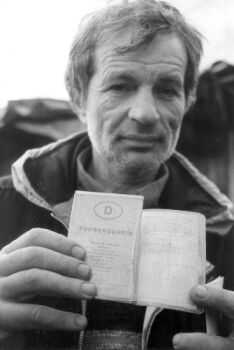 |
| The Koželjeva street settlement, Ljubljana, February 2001: Mr Lutvo Ribić is a Bosnian Romani man who has lived in Slovenia since 1976. In autumn 2000, the local traffic police stopped Mr Ribić as he was driving a truck, and asked for his licence. Mr Ribić showed the officers his German driver's licence from 1992, with unlimited validity. His Slovene licence expired in 1994, and Mr Ribić could not extend it because he was no longer legally resident in the country. For allegedly driving without a proper licence, he later received a bill for 180,000 Slovene tolars (approximately 840 euros at the time of the interview), replaceable by 18 days in jail. As Mr Ribić had no money, he chose to go to jail, and served the sentence. On February 26, 2001, the staff of the German Embassy in Ljubljana told the ERRC that German driving licences, as possessed by Mr Ribić, should be valid and accepted in Slovenia. Mr Ribić has filed an application for permanent residence, and as of July 19, 2001, had been waiting for approximately one year without response from the Slovene authorities. Photo: Tim-Simon Rohardt |
The current procedure for applying for Slovene citizenship is still unfamiliar to many Roma. Roma claim that the authorities request that they submit many documents, and that the requirements are on the increase. The requirements are seen as unfair, among other reasons because many Roma claim that the sum of money they are required to show as monthly income is higher than the average salary in Slovenia. Most also complained of the catch-22-like requirement of having a permanent source of income, as in Slovenia one has very little legal possibility of employment if one is not a citizen. The few who manage to resolve this quandary are primarily those who open private firms, but for most impoverished Roma this is an unrealistic option. For many Roma, it has been impossible to travel to other parts of former Yugoslavia, their places of origin, to procure the required original documents such as birth and marriage certificates, due to war and the possibility of falling victim to an ethnically motivated attack.
Many Roma also complained that police deliberately target and harass Roma without documents, and apply arbitrary sanctions. In some cases the police have allegedly told Roma without documents "to go back where you came from," and called them "Gypsies". There are also reported cases of Roma being deported or threatened with deportation after being caught without documents by the police. One example is Mr Zijo Ribić, a 26-year-old Romani man who has lived in Slovenia since the age of three15. On October 1, 2000, Mr Ribić was driving a truck in the Ljubljana area when the police stopped him and asked for his documents. Mr Ribić showed a Bosnian passport, which contained an expired visa for Slovenia. At the time, according to testimony provided to the ERRC, Mr Ribić had applied for a Slovene residence permit, and had done so while the visa was still valid16. The police told him that he had to leave the country, as he was present "illegally". They took him to a police station in the Moste part of Ljubljana, from which he was transferred to a detention centre. On the following day, the police took Mr Ribić to a magistrate, where he was fined and handed back to the police. Without a deportation order, officers then reportedly took Mr Ribić to the Slovene/Hungarian border, with the intention of deporting him - a citizen of Bosnia and Herzegovina - by putting him on a bus for Belgrade, via Hungary. When the bus arrived, Mr Ribić refused to board it, following advice from a member of the Helsinki Monitor of Slovenia. After a prolonged and heated discussion, including verbal abuse by the police, the police took Mr Ribić back to a transit centre for foreigners in Ljubljana, where he was held over the weekend. In the meanwhile, his father-in-law, a Slovene citizen, had signed a guarantee for Mr Ribić and he was released.
Most of the "non-autochthonous" Roma interviewed by the ERRC expressed deep disappointment with the fact that the country in which they have lived for decades, to which they have formed legitimate ties, and in which their young children were born, has overnight chosen to deprive them of equal treatment with the rest of the population, or at best treat them as foreigners. An official defended the government approach by explaining to the ERRC that "foreigners living in Slovenia do not have an automatic right to Slovene citizenship," and that it makes no difference in terms of citizenship if "someone has been living in Slovenia for years.17" Government officials who maintain as such disregard the fact that, for most of these years, Slovenia had been an integral part of the country of origin of an overwhelming majority of people now applying for Slovene citizenship, a consideration of paramount importance under international law.
A law never adopted: Roma in and out of Slovene legislation
On November 30, 1995, the Slovene Government adopted its first document specifically addressing the problems of Roma: the "Programme of Measures to Assist Roma in the Republic of Slovenia." The programme proceeds from the premise that "Roma, who live autochthonously in our state, are a vulnerable population group, and a great number of them cannot rise from their general backwardness, poverty and discrimination without organised help.18" In the introduction to the programme, the government recognises that assistance to Roma should not be only the duty of municipalities, but of the national government as well. Various governmental ministries and agencies were asked to address issues pertaining to Roma, and the final outcome addressed living conditions, education, employment, family care, social care, health care, prevention of crime, the cultural development of the Romani community, information provided to Roma and assistance to Roma to organise themselves for inclusion in local self-government. All the agencies commissioned with particular tasks within the programme were asked to submit reports on the realisation of their tasks to the government by November 15, 1996. The first official assessment of the 1995 programme's impact was nevertheless not published until June 1999, by the Office for National Minorities, in the "Report on the Implementation of the Programme of Measures to Assist Roma in the Republic of Slovenia in 1997 and 1998." The report evaluates each of the items of the 1995 programme, and briefly lists the achievements of the government in certain areas.
The initiative was expanded in the year 2000, with the Ministry for Labour, Family and Social Affairs' "Programme for the Employment of Roma in Slovenia", which analysed the living conditions and the economic situation of Roma, and provided proposals for the inclusion of Roma in the work force.
Nevertheless, some basic issues related to Roma in Slovenia have not been addressed. Their rights are not nearly as protected as the rights of the Italian and Hungarian ethnic groups. A crude but telling comparison is the length of Articles 64 and 65 of the Slovene Constitution: Article 65, addressing the status and rights of Roma, is "one of the shortest in the Constitution,19" stating simply the following: "The status and the rights of Roma communities living in Slovenia shall be such as determined by statute.20" By comparison, Article 64 of the Slovene Constitution recognises a whole range of rights pertaining to the Hungarian and Italian ethnic minorities, regardless of their numbers, including, but not limited to, the official use of language and education in mother tongue, and direct representation on the local level and in the National Assembly. However, ten years after the newly independent Slovenia adopted its Constitution, a law on Roma has not yet been adopted. In 1995, the government then in office came to the conclusion that "there is no need to formulate a special law to protect the Romani community.21" The reasoning frequently given to Romani advocates is that there are provisions for Roma in individual laws, such as legislation pertaining to education, local elections, and local self-government. However, these provisions are considered deeply unsatisfactory in the eyes of Slovene Romani leaders interviewed by the ERRC, and the need for a special law is seen as crucial. The government appears to have adopted its programmes in an effort to avoid the constitutional obligation to address issues pertaining to Roma by adopting a law. A law as envisaged in Article 65 would mean that the government would be legally bound by the provisions adopted therein. As the subsequent examination of the achievements of the programmes will make clear, there is a desperate need for any measure which will force the government to address seriously in practice the needs of the Roma in Slovenia. The failure to act upon Article 65 has meant that Roma are too often subjected to little more than good intentions, ill-conceived plans and a lack of commitment.
Rights in theory only: political representation of Roma22
One of the few legal provisions for Slovene Roma, Article 39 of the Slovene Act on Local Self-Government, adopted in 1993, states that, "In the regions where autochthonous Roma live, Roma will have at least one representative in the municipal council.23" To affirm their support for this initiative, in its 1995 measures for the improvement of the situation of Roma, the Slovene government assigned its Office for Local Self-Government Reform the competence to monitor and ensure the implementation of this article. The Office was given the task of examining the ordinances of individual municipalities with a Romani population, and the municipalities were to harmonise their ordinances with the Local Self-Government Act.
Unfortunately, the situation in the field indicates that the right of Slovene Roma to adequate political representation remains merely a right on paper in the overwhelming majority of municipalities in which Roma live in Slovenia. The municipality of Murska Sobota, in the Prekmurje region, where Mr Darko Rudaš, a Romani man, is a member of the municipal council, is a notable exception. The local Romani population, numbering around 1200 persons, has had its own representative for the past six years. Mr Rudaš, the current councillor, has held office for the last two of these years. Apart from the municipal council, which sits once a month, there is also a municipal Commission for Romani Issues, of which Mr Rudaš is the president. The Commission consists of one Romani representative in addition to Mr Rudaš, five non-Roma representing various political parties, and one non-Romani member not belonging to any political party. In Mr Rudaš's opinion, the work of the Commission is good, and it is actually through the operations of the Commission that the situation of the local Romani community has improved24. Mr Rudaš, however, does not have an independent budget, and has no right of veto in either the Commission or the local council; he also expressed the need for an office where community members could come and state their concerns.
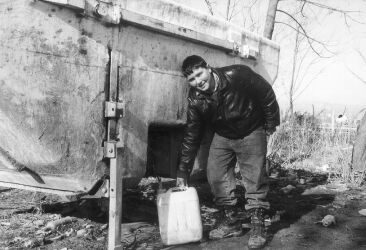 |
| The Kerinov grm settlement, Gorica near Krško, February 2001: The municipality delivers water to the only cistern in the 180-strong settlement every Tuesday and Friday. The same container has reportedly been used in Kerinov grm for twenty years, and the locals claim that it is disinfected only once a year, and only after their requests. The water from the container serves for all purposes, cleaning and tap water as well. The quality of water is reportedly better in autumn and winter, because low temperatures hinder the growth of bacteria; in summer, the water is of a much lower quality, and the Roma fear that their children have fallen ill as a direct result of the water. According to local Roma, on one occasion the water brought to the container was so foul that they refused to accept it, and it had to be replaced. Photo: Tim-Simon Rohardt |
Despite these problems, however, the benefits of a Romani presence on the municipal council are evident. Pušča, the largest Romani settlement in the municipality, housing around 700 Roma, has in the last two years been provided with street lights, water supply to all houses, a road to the settlement, a new bus stop, and regular waste removal. Additionally, a number of roofs have been repaired. Many problems reportedly remain, but at the time of the ERRC interview, Mr Rudaš was confident that all issues would be addressed in time, now that Roma have political representation at the municipal level.
ERRC research suggested, however, that Murska Sobota is an isolated example. In Novo mesto, Dolenjska region, Roma have had to resort to legal action in order to exercise their right to adequate political representation. Mr Rajko Šajnović, the former president of the local Romani association Rom in Novo mesto, wanted to run for the office of the municipal councillor in late 1998, and was reportedly told that he could not run as a representative of Roma, but only as an independent citizen25. Mr Šajnović considered this a breach of Article 39 of the Act on Local Self-Government, and filed a complaint with the Constitutional Court, asking the court to judge the lawfulness of the ordinance of the Novo mesto municipality.
More than two years later, in its decision of March 22, 2001, the Constitutional Court of Slovenia issued a judgement stating that the ordinance of the Novo mesto municipality is not in accordance with the Act on Local-Self Government, as it "does not allow the local Romani community, autochthonously settled in the territory of the Novo mesto municipality, to have its own representative on the municipal council.26" The Court also ruled that the Act on Local Self-Government is itself unconstitutional, as Article 39 offers an opportunity for the political representation of Roma without envisaging concrete procedures for the realisation of this right in practice. Additionally, according to the Court's reasoning regarding the act, it is presently unclear to which municipalities this article applies, and there is also no definition in Slovene official documents of the term "autochthonous", used in Article 39, despite its frequent use by Slovene officials. In the eyes of the Constitutional Court, such incomplete legislative regulations violate Article 2 of the Constitution of Slovenia27. The Court ordered amendment of the Novo mesto ordinance within six months of the judgement, and allowed a year for amendment of the Act. The real impact of this decision, and its possible influence on other, similar situations in Slovenia, remains to be seen.
The example of the Murska Sobota municipality makes clear that the free exercise by Roma of their political rights is crucial for good co-operation with the non-Romani authorities. As such opportunities hardly exist in reality, due primarily to an evident lack of good will on the part of municipal authorities and a lack of necessary pressure on the former by the government, Romani voters are left with the choice of voting for non-Roma, or abstaining from voting. In most of Slovenia, Romani voter turnout is reportedly very low, and many Roma state that this is because Roma do not trust the non-Romani politicians. They "all visit just before the elections and make promises which never come true," as one Romani community leader stated28.
In order to affect real positive change in the political participation of Roma, the Slovene government should provide regulations such that the right of representation for Roma, recognised by the Act on Local Self-Government, can be adequately realised in practice. The Constitutional Court's decision could serve as a starting point: the government should elaborate clear and precise definitions of the terminology it uses, and precisely define the geographic areas affected by the Act, with maximum possible inclusion of Roma as a goal. Furthermore, municipalities should be given clear instructions on the implementation of such measures. The Office for Local Self-Government Reform should be provided with a definite mandate in monitoring this process, and the power to enforce the change of ordinances in particular municipalities. The state should assist Romani communities in their political development through adequate training programmes, voter education, and financial and advisory support to Romani associations working towards Roma participation. Last but not the least, as in the case of ethnic Hungarians and Italians, the Romani community of Slovenia should be given the right to guaranteed representation in the Slovene parliament.
Gordian knots: housing issues
Addressing the housing concerns of Slovene Roma in the 1995 programme, the Slovene government pledged that the Ministry of the Environment and Spatial Planning would offer "expertise and material assistance" in the preparation of documents for the legalisation of Romani settlements. The programme encourages non-profit housing organisations to apply for governmental funding, provided that they assure the provision of so-called "social housing"29. According to the programme, the Ministry should also pay special heed to the specific needs of local communities in the areas where Roma live.
The fact that many Slovene Roma single out inadequate housing as their main problem testifies to the importance of this issue. The specifics of the problem are various � from Romani settlements built illegally on land owned by non-Roma, to the vehement refusals by non-Roma to admit new Romani neighbours to their settlements.
A 1999 government report estimates that of the 39 percent of Slovene Roma who live in houses, almost a half built their homes without adequate licences or permits30. The illegality of Romani settlements is a widespread phenomenon in the Dolenjska and Bela krajina regions of southeastern Slovenia. The reasons for lacking legal tenancy are various: the Kerinov grm settlement in Gorica near Krško, Dolenjska region, for example, came into existence around 25 years ago, as a group of tents initially, and the community has since grown to become a settlement of some thirty families with a number of solid houses, built only in the last 5-6 years. The land on which the Romani community is located belongs to a number of owners, some of whom live abroad, and some of whom have tolerated the settlement reportedly believing that the Roma would eventually move away. The settlement has no electricity and no running water supply, nor does it have public transport connections to any of the neighbouring villages. None of the adults are employed, and the entire settlement survives on social assistance, as well as collecting scrap iron for resale.
In 1995, the Krško municipality put an official in charge of resolving issues related to the housing of the Roma living at the Kerinov grm settlement31. The municipality succeeded in obtaining the agreement of around twenty-five owners of the pieces of land where the Roma currently reside that they would sell the land. The intentions of the municipality are either to give the land in question to Roma living on it, or to allow them to use it. However, an important obstacle to the scheme is that the land is registered with the authorities as land for agricultural use, and the Slovene legislation on spatial planning forbids building on such land. In such cases, special permission has to be obtained from the Ministry of Agriculture, and as of August 24, 2001, the Krško municipality had been negotiating with the Ministry for almost two years without success.
Another problem in legalising this settlement is the fact that the land where the Roma live is located in the middle of a plain that is in the process of redistribution. This effort by the authorities entails a redrawing of land registries such that a number of owners of several smaller pieces of land in this field will each receive one piece of land equalling the sum of the area of the previous pieces, in order to make access to and cultivation of the land easier. As of February 2, 2001, this process had been halted due to the unsolved status of Kerinov grm, as this particular piece of land should be exempt from the process, pending its successful legalisation. Additionally, according to the Krško municipality officer in charge of the process, none of the owners want to receive land bordering the Romani settlement after the reallocation, as they reportedly fear thefts and destruction of crops by Roma. At the same time, the municipality is working on a water supply project, hoping to finish the project by the time that the problem of the legality of the settlement is resolved32. They hope that this issue will be solved within the next two years. Local Romani activists, however, were mistrustful that the municipality was wholeheartedly engaged, and they thought that this problem could have already been solved, had the authorities been genuinely concerned about the situation of local Roma33.
Another example of the failure to solve Romani housing problems is the Grosuplje case, in the Dolenjska region. In this municipality, southeast of Ljubljana, local authorities have created a ghettoised, substandard settlement for the local Roma. In the process of placing the Roma in one settlement, begun in summer 1998, the municipality has moved the families several times, including one forced removal aided by local police.
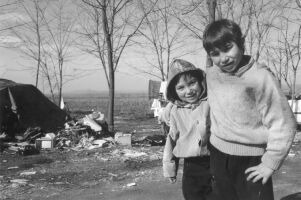 |
| The Kerinov grm settlement, Gorica near Krško, February 2001: the Romani settlement is located on land that belongs to a number of non-Romani owners. The community has been living on that land for about 25 years. There were around thirty families living at the settlement at the time of the ERRC visit in February 2001. None of the adults are employed, and they live on collecting scrap iron and social assistance. There is no running water supply and no electricity in the settlement, and no bus connection to any neighbouring place. The only road to the settlement was built by the Roma themselves with the materials provided by the municipality. Photo: Tim-Simon Rohardt |
At first, a group of forty-three Roma living for more than thirty years on private land in the hamlet of Rojnik, Grosuplje municipality, were asked to leave their homes in June 1998. As they had no other place to go, the Roma established a camp near the municipal building34. In September 1998, the municipality suggested that the group move to the industrial zone of Grosuplje, which they did. Approximately one year later, the owner of the land threatened to press charges against the municipality over the presence of the Roma. At the same time, another Romani settlement, located behind the Grosuplje train station, was on recently restituted land35. Consequently, the municipality announced plans to move both communities to a new location in Grosuplje, referred to as either "Smrekec" or "Z smrekcem," promising to provide housing in containers, and to supply the settlement with electricity and water. In November 1999, the press reported that the removal of Roma had been halted, as there was no money to buy the 15 square metre containers because the governmental bodies that had initially promised financial support had withdrawn it. Around one year later, the Roma were eventually moved to the Smrekec location. While the Rojnik group moved in voluntarily, the attempt to move the train station group was performed with the assistance of the Grosuplje police and a special police unit. However, fearing the use of force by the police, the Roma from the group fled before the police arrived. Again, the mayor promised water and electricity supply in the new settlement36.
The ERRC visited Grosuplje on February 7, 2001. The Roma from the train station group told the ERRC that they had made it clear from the start that they had not wanted to move to this particular location together with the other Romani group, with whom they were in personal conflict, and that they would not oppose moving, but to a different location. According to testimony by victims and witnesses, on the morning of the action, immediately before the arrival of the police, most of the Roma fled into the woods, as they had heard threats that the adults would be jailed, and their children taken to state institutions. After around one month in the woods, with a number of their children developing illnesses, they approached the mayor. When they finally returned to their previous settlement, they found everything burnt down, including the ten prefabricated shacks in which they had lived, and the land ploughed up37. Apparently the shacks were burnt down together with their possessions. A man complained that he had previously bought wood for heating, but the police had burnt it all. The other Romani group opposed the move to Smrekec, but reportedly agreed to it after the mayor told them they would be moved by force if they resisted.
A lawyer in charge of the department for general matters within the Grosuplje municipality told the ERRC that the Roma in question had lived on other people's land for years, in three locations, in settlements without infrastructure, with a growing number of inhabitants38. He said the Roma had a high standard of living and good conditions in the new location, and said that he had received complaints from Roma that the containers are too small, but added that "[the municipality] could do nothing about it," as it had already invested a large sum of money into solving this problem, which had been unpopular with non-Roma.
In fact, Smrekec is located on the very outskirts of the town, behind a row of industrial buildings, in a gloomy looking, swamped area. The two Romani communities in conflict are divided by a canal full of putrid water (which the municipality referred to as a "brook") which, according to the Roma, overflows in rainy weather and floods the shacks on the banks. On the left side of the canal, the group that was removed from the train station area, consisting of around 45 persons from the Hudorovec family, lives in ten small containers, all of the same shape and size. On the right side, the Romani family Brajdić - approximately sixty people - is accommodated in seven huts, one container and one caravan. The Roma report that there is too little space for everyone; one of the containers hosts as many as four adults and eight children, and there is hardly enough space for everyone to sleep. The containers have very small windows, and some of the women reported that they have to leave the doors open during the day in order to get some light. Additionally, the containers are all set very close to each other, on a rather small platform, which does not allow for privacy.
The sanitary facilities consist of two cabins, in each settlement, at the ends of the rows of containers. In each cabin there are only two separate toilets for men and women, with one tap per toilet providing cold water for more than one hundred people. There is a water boiler on each side of the cabin, but since there is no electricity supplying them, they do not work39. At the time of the ERRC visit, the pipes below the sinks were leaking, and the floor of the entire cabin was covered in dirty water. According to Roma, in cold weather the water freezes in the pipes, and they have had no water at all for various periods of time. The Roma also reported that the sewage runs out of the cabins nearby the containers. There was one small container for garbage, emptied every Tuesday and Friday by the communal service, but the Roma complained that the container was too small to address the waste-disposal needs of the community. One of the Romani men at Smrekec had bought a power generator, as his 63-year-old mother suffers from asthma and needs to have her breathing apparatus turned on at all times. From this generator, electricity is distributed to some other containers as well. Both groups were united in their opinion that they were better where they were before, and that they wished they could have stayed there.
As for their status, Roma in the new settlement have received from the mayor a document entitled "The agreement on the usage of land with a concrete platform and the containers and the sanitary cabin". According to the agreement, the Roma are charged a symbolic rent of 1 Slovene tolar (less than 1 euro) for the use of the containers. Article 11 of the agreement specifies that the usage is for three months, and the agreement bears the date of December 22, 2000. At the time of the ERRC visit on February 7, 2001, the Roma had no other documents relating to their accommodation in Smrekec. They also did not know what would happen at the expiry of the three months.
The Roma at Smrekec also heard that there were plans at the Mayor's office to move a third Romani community, currently living next to a woodwork factory called Oaza, into this settlement as well, which they see as the mayor's attempt to segregate all the Grosuplje Roma into a "Romani village". If this happens, the Grosuplje Roma would be fully ghettoised.
The vast majority of Roma in Slovenia live in manifestly substandard accommodation, with no municipal infrastructure provisions. Šmihel is a small Romani settlement in the Dolenjska town of Novo mesto. It came into existence more than fifty years ago, and in the 1970s the municipality built a row of eight flats for Romani families on municipal land. In time, the settlement expanded, as other Roma built their own homes adjacent to it. At the time of the ERRC visit in February 2001, the Roma in Šmihel had been without running water for reportedly more than a year, as the state-run water supply company had shut off supply to all the dwellings reportedly because of a number of individual non-payers40. According to those who live there, the municipality has removed garbage only twice since 1993. Slovene media have reported that the municipality announced several plans in November 1999 to improve the settlement, but the ERRC field visit discovered no positive changes41.
Furthermore, there have been situations in Slovenia in which Roma have lawfully purchased housing or land, and yet were prevented from settling by their non-Romani neighbours. In September 1999, the local press reported on a case in the village of Mirna, in the Dolenjska municipality of Trebnje, in which a Romani family had bought an old house that they wanted to refurbish. In response, non-Romani neighbours reportedly collected signatures against the relocation of the family42. Roma in Dolenjska claimed that this is a very common occurrence, but that only some cases reach the press. According to the Ministry of Interior, one of the four cases of incitement to racial and religious hatred reported in Slovenia since 1991 pertains to a similar situation43. In the case, in July 1998, non-Romani villagers of Jelšane, southeastern Slovenia, collected signatures against the settlement of a Romani family, and stirred up intolerance against Roma in the village. According to a fax from the Public Prosecutor of Slovenia to the ERRC dated May 30, 2001, in February 1999, the County Court in Ilirska Bistrica opened proceedings against two villagers in relation to this case. As of May 31, 2001, according to the Public Prosecutor, the main hearing in the case had not yet taken place.
Even in the Prekmurje region, where all Romani settlements are reportedly legal, the enmity of non-Romani neighbours remains a problem, and there are ongoing efforts to segregate Romani communities to an even greater extent than they already are. In the Murska Sobota municipality, in November 1999, the president of the Černelavci local community set up a local referendum to decide on the removal of the Romani settlement Puš?a from their administrative unit. The non-Romani villagers voted overwhelmingly for the separation. The Romani community, however, was against the separation, and organised their own referendum, voting to remain a part of the same administrative unit. According to the local Roma, the unstated cause of the affair was a local graveyard, which the non-Roma reportedly did not want to share with Roma. The municipal Commission for Roma Issues intervened to request that the graveyard serve both communities, and accepted a proposal by members of the Romani community that the administrative separation be implemented only when their community has all the necessary means to survive as a separate administrative unit, such as having a building for the public offices. The Mayor of Murska Sobota has reportedly agreed to the Commission's proposal, and, in the opinion of the Romani councillor, any separation is unlikely to take place before 200444. Nevertheless, it appears that absent external intervention, Černelavci will rid itself of the Puš?a settlement eventually.
The situations described would suggest that, six years after the adoption of the programme for Roma, the situation of Roma in Slovenia shows little sign of tangible improvement. On the contrary, the authorities' methods of addressing the housing issue have involved coercion, forcible removal and segregation, while the government's financial investment in solving this issue has been negligible. In 1999, the government review of the 1995 programme reported that the budget line envisaged for the support to municipalities in their efforts to regulate Romani settlements was "merely symbolic". The review's chapter on housing ends with the note: "If we do not ensure earmarked means for the regulation of conditions in the year 2000 budget, we can easily expect that the opposition between the Roma and the local population will only deepen and increase, and the municipalities, with their modest means, will only be able to calm down tensions and partially solve the most pressing problems." Two years on, funding has not increased. The Slovene authorities also seem unable to organise their own ranks, and while municipalities highlight the lack of financial resources and insist that this is a problem to be solved on the level of the state, governmental institutions, in return, respond that this is a municipal issue. The continuing existence of such problems is even more lamentable when one considers that, as early as 1997, an internal government report on the implementation of the 1995 programme's housing proposals noted that progress on the legalisation of Romani settlements had failed to meet expectations, and warned of insufficient co-operation between state organs and municipalities.
Challenges not met: unemployment on the rise
In its 1995 programme, the government set the following tasks in relation to the improvement of the Romani employment rate: the Ministry of Labour, Family and Social Affairs was assigned the duty of promoting various forms of Romani self-employment, and ordered to undertake an examination of ways to encourage employers to hire Roma. The Ministry of Economy was to support Romani initiatives for the development of production, trade and personal services, while the Employment Bureau was asked to:
- finance public works schemes which employ Roma in projects aimed at the improvement of living conditions of Romani communities;
- develop special training programmes for young Roma who wish to work in construction, agriculture or communal services45;
- order its local offices to secure employment for Roma; and
- additionally train its employment advisers in how to work most effectively with the Romani community46.
The 2000 programme, fully entitled "Equality of Employment Possibilities for Roma - Our Joint Challenge: The Programme for the Employment of Roma in Slovenia", develops some points of the 1995 government programme. It analyses the economic situation of Slovene Roma, and offers proposals for reducing the unemployment rate among Roma. The government's main approaches are: preparation for employment and training, establishment of Romani cooperatives, a public works scheme and subsidised employment. The programme also envisages that implementation be supervised by the Group for the Coordination of the Employment of Roma and the Employment Bureau, and calls for the formation of two project groups to be in charge of the implementation of programmes in the Dolenjska and Prekmurje region. On June 4, 2001, the Employment Bureau informed the ERRC that the Coordination Group had not yet been established.
In sharp contrast to the expectations following the introduction of the 1995 programme, most of the Slovene Roma interviewed by the ERRC agreed that the situation in employment has actually significantly deteriorated in the last five years. Field visits to Romani settlements provided ample evidence to support this claim. In the deeply impoverished Romani settlements in the Dolenjska region, for example, none of the Roma had legal, full-time employment, and they made a living by collecting and re-selling scrap iron. A small number of Roma earned a living through occasional seasonal work on local farms, or in the construction industry.
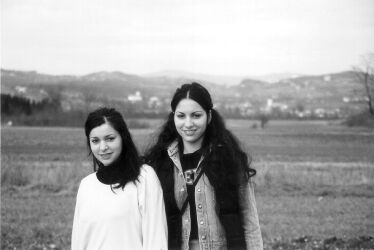 |
|
Drnovo, February 2001: Ms Nataša Brajdiè, on the left, with her sister Mihaela. Ms Brajdiè was the only Romani candidate for participation in a re-qualifyng programme in October 2000; she was also reportedly the only candidate whom the employment bureau asked to take an intelligence test. |
In the municipality of Murska Sobota, which has the highest registered number of Roma in Slovenia, unemployment is very high, as most of the city's industry, once the lifeline of the region, has now closed down. The layoffs have struck Roma the hardest: in 1991, 57 percent of adult Roma in the Pušča settlement were employed, while at the time of the ERRC visit in 2001, only 72 of the 700 Roma had jobs, mostly in the local textile factory Mura, which is the biggest employer in the municipality, or in a local public works project47.
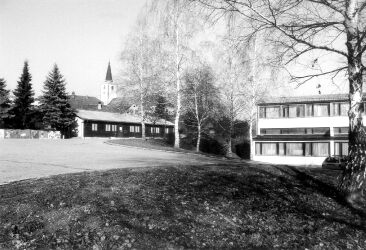 |
| Leskovec pri Krškem, February 2001: In the local primary school, Romani children in grades 1-4 attend separate classes in a separate school building. The “Romani” school building is on the left in the photograph, while the main school building is on the right. Photo: Tim-Simon Rohardt |
"Non-autochthonous" Roma are especially burdened in the field of employment. A number of "non-autochthonous" Roma lost their jobs after 1991, as they were not citizens of the newly-independent Slovenia, and as such could not be employed51. Such is the case of the family of Džemalj and Špresa Šotani, originally from the town of Peć/Pejë in Kosovo. Mr and Mrs Šotani have lived in Slovenia for twenty and fourteen years respectively; since 1993, they have lived in the village of Ruše near Maribor, with their four children, who were all born in Slovenia52. In 1993, Mr Ĺ otani lost his job with the local state-owned waterworks company, because he could not obtain the citizenship of the new Slovene state. His brother, who worked for the same company, lost his job several months later. As a result of losing their jobs, the Šotani brothers and their families lost the right to reside in the house the water company had provided for them in early 1993. They have been asked to leave the house without having any alternative accommodation. The families themselves have no relatives in the country to assist them and no means of gaining other accommodation - at the time of the ERRC visit in February 2001, all members of the family were unemployed.
Those few "non-autochthonous" Roma who have in the meantime procured Slovene citizenship can register with the local employment bureau, but their numbers are quite low. For example, in Maribor, which has a "non-autochthonous" Romani community of more than a thousand, only 69 Roma were officially registered as unemployed in January 199853. According to Mr Fatmir Bečiri, a local Romani leader in Maribor, Roma are particularly affected by unemployment: only some 70-80 Roma are employed in Maribor, as railroad workers, cleaners or sales assistants54.
The government's Romani employment programmes apparently have not been made widely known. Of the Roma and government officials interviewed by the ERRC throughout Slovenia, alarmingly few knew about the existence of the programmes at all, and none stated that there had been any practical positive impact of the programmes in their area. Criticism was mostly directed at the way in which the public works scheme is funded, as it reportedly offers payment only at the level of social aid, and therefore offers little incentive. In an illustrative example - one that would have been humorous if the Roma concerned did not live in such poverty - Romani workers employed through a public works scheme eventually got paid in jars of gherkins, as the company employing them did not have the money to pay them55.
Separate desks: Roma and education
In the 1995 programme, the Ministry of Education and Sports committed itself to a number of concrete measures related to the education of Romani children in Slovenia. In co-operation with local municipalities, the Ministry was to involve Romani children in kindergarten activities at least two years before they begin attending school. Schools with Romani pupils were given the possibility of additional instruction hours. The initiatives of schools encouraging "the socialisation of Romani students and their study success" would be given priority over other projects and financed by the Ministry. The Ministry would also assure funds for free meals for Romani students, and assist schools in purchasing books for Romani students56. The Ministry was to commission projects for the education of Romani children and initiate the adaptation of general programmes for Romani children. Romani university students in the field of education would be able to apply for government scholarships. A group of experts was to be formed to create a curriculum for teaching the Slovene language to Romani children.
The importance of the timely inclusion of Romani children into the educational system has been widely acknowledged. However, in Slovenia there is a fee for attending kindergarten. As many Roma in Slovenia cannot afford to send their children to kindergarten, and as the government does not provide financial support to families in need, the economic deprivation of the Romani community hinders their children from getting an adequate start.
In terms of the numbers of Romani pupils, there is evident progress in attendance at elementary schools. However, this success is not reflected at the secondary or tertiary level. Currently, around 1200 Romani children attend primary schools in Slovenia. Most of them finish primary school, but the number of those who continue to secondary schools is much lower57. In the Pušča settlement, for example, all the children attend primary school, but a significantly lower number continue on to secondary education. Only about one half of primary school graduates continue on to high school, discouraged by the widespread unemployment that effects educated and non-educated Roma alike. The ERRC has also heard concerns expressed that vocational advisors pay little heed to the talents of individual Romani children, but direct them automatically to vocational schools, where they will not be prepared for highly-paid and prestigious professional careers.
Furthermore, a number of Slovene schools are racially segregated. In the primary school in Leskovec near Krško, the school authorities segregate Romani children of kindergarten age and in grades 1 to 4 not only into separate classes, but to a separate building. Until two years ago, when the school leadership changed, Romani children were segregated only in the first grade. Later, the segregation expanded. According to Roma whose children attend this school and non-governmental activists involved in work with the community, the classes for Roma are different and the teacher's standards lower and more lenient, so that when Romani children start attending integrated classes in grade 5, they are less prepared than their peers and have difficulties integrating. The transfer from segregated to integrated classes at a late age is reportedly stressful and unpleasant for Romani children, and in some cases they experience open hostility from their non-Romani peers. The school authorities reportedly find support for the whole scheme in works by educational experts, and it has support among non-Romani parents. It is unclear why such racial segregation is allowed. In an interview with the ERRC, an official from the Slovenian Ministry of Education confirmed that there are seven Roma-only classes for grades 1-4 in Slovenia, and in practice, pupils show better results in schools where Romani children attended integrated classes. However, it is reportedly up to the schools themselves, and not the Ministry, to decide whether classes are segregated58. The ERRC found no evidence of educational or other authorities condemning such discriminatory policies by individual schools.
Another reason for concern is the disproportionate placement of Romani students in schools for children with disabilities. According to one expert, 13.9 percent of the total of 1067 Romani primary school pupils in Slovenia in the school year 1998/99 were in special schools for children with various forms of disabilities59. In the Gustav Šilih school for children with special needs in Maribor, there are 40 Romani students, mostly Kosovo Roma, out of 270 students in total. The school is designed to meet the needs of children with mental and/or physical disabilities, as well as children with other learning difficulties. These figures are evidently disproportional when compared to the percentage of Roma in the general population. The explanation offered by an official of the school was the lack of knowledge of Slovene, the social status of the Romani children, and difficulties in the "socialisation" of Romani children60. According to the same source, at least 70-80 percent of the Roma in the school do indeed have disabilities, and need special assistance in the learning process, while the rest are there as their learning difficulties stem from reasons such as not adapting well to the school environment. Many Romani parents told the ERRC that they were concerned that the placement of their children in such institutions results in the child's loss of dignity, and eventually, low-quality education with meagre future prospects.
The government should provide financial assistance to poor families for kindergarten fees, or provide for a system of kindergarten fee waivers, in order to increase the number of Romani children who attend kindergarten. Secondly, better vocational guidance should be offered to Romani students in their final grades of primary school, and support in terms of scholarships, books and travel expenses should be offered to Romani high school students as well. Most importantly, the practice of segregation must be immediately abolished, in accordance with Slovenia's international legal commitments.
Conclusions: inadequate measures, implemented partially
The Slovene government has, without doubt, taken the necessary first steps towards the inclusion of Roma in Slovene society, and made the right noises about the desperate need to improve their situation. However, the 1995 and 2000 programmes, as they presently stand, are inadequate to address the real challenges presented by the situation of Roma, and the striking vagueness of the programmes serves to justify their irresponsibly slow realisation in practice. The idea of expanding the rather brief 1995 programme into separate and more detailed reports, as in the case of the 2000 employment programme, is worthy of further efforts. Additionally, the government must adopt concrete measures that leave no space for ambiguity and ensure real implementation of the ideas presented in the programmes. It must adopt a law on the Romani community, as provided for in Article 65 of the Constitution, and must protect the rights of Roma with comprehensive anti-discrimination legislation, currently non-existent61. Last, but not least, the Slovene government must remedy the injustice it inflicts on the so-called "non-autochthonous Roma", and indeed offer protection to all "Roma living in Slovenia," as provided under Article 65 of the Constitution of Slovenia. The Slovene government should, without delay, take measures to provide Slovene citizenship to all "non-autochthonous" Roma who request it, and widen the scope of their Roma-related programmes to all Roma in Slovenia.
Endnotes:
- Tatjana Perić is Researcher/Monitors Coordinator at the ERRC.
- The Slovene Statistical Office, according to the 1991 population census, available at http://www.sigov.si/zrs/leto00/04.htm.
- European Roma Rights Center interview with Mr Jožek Horvat, president of the Association of Roma in Slovenia, Murska Sobota, February 6, 2001.
- The Constitutional Court has ruled recently that the Slovene Act on Local Self-Government is unconstitutional, among other reasons because the term “autochthonous” — found in the law — has no definition other than the one found in Slovene dictionaries.
- See Article 39 of the “Zakon o državljanstvu Republike Slovenije” (Citizenship Act of the Republic of Slovenia), published in the Official Gazette of the Republic of Slovenia No. 1/91, page 6, Ljubljana, June 25, 1991. An official translation was made available to the European Roma Rights Center by the Public Relations Office of the Slovene Ministry of Interior on December 19, 2000. States are obliged to work to end statelessness on their territories, a fact attested to by the existence of two international Conventions aiming to reduce it and/or ameliorate its effects — the 1954 Convention Relating to the Status of Stateless Persons and the 1961 Convention on the Reduction of Statelessness. Slovenia is a signatory to the former, which states, inter alia, “The Contracting States shall as far as possible facilitate the [...] naturalization of stateless persons. They shall in particular make every effort to expedite naturalization proceedings and to reduce as far as possible the charges and costs of such proceedings.” (Article 32). Statelessness and citizenship issues have recently been high on the European agenda and, reflecting these concerns, in 1997, the European Convention on Nationality was adopted. According to the Convention, under Article 4: “The rules on nationality of each State Party shall be based on the following principles:
a) everyone has the right to a nationality;
b) statelessness shall be avoided;
c) no one shall be arbitrarily deprived of his or her nationality;
d) neither marriage nor the dissolution of a marriage between a national of a State Party and an alien, nor the change of nationality by one of the spouses during marriage, shall automatically affect the nationality of the other spouse.
Article 5 of the Convention further states that:
i) The rules of a State Party on nationality shall not contain distinctions or include any practice which amount to discrimination on the grounds of sex, religion, race, colour or national or ethnic origin.
ii) Each State Party shall be guided by the principle of non-discrimination between its nationals, whether they are nationals by birth or have acquired its nationality subsequently.”
Moreover, the Convention importantly sets down that conditions regulating the acquisition and loss of citizenship in the context of state succession are fundamentally different from those governing acquisition and loss of citizenship normally. Here, the necessity of avoiding statelessness is paramount. The Convention states, under Article 18 of Chapter VI, which deals exclusively with citizenship in the context of state succession:
“i) In matters of nationality in cases of State succession, each State Party concerned shall respect the principles of the rule of law, the rules concerning human rights and the principles contained in Articles 4 and 5 of this Convention and in paragraph 2 of this article, in particular in order to avoid statelessness.
ii) In deciding on the granting or the retention of nationality in cases of State succession, each State Party concerned shall take account in particular of:
a) the genuine and effective link of the person concerned with the State;
b) the habitual residence of the person concerned at the time of State succession;
c) the will of the person concerned;
d) the territ