
ERRC Takes Legal Action For Romani Refugee Children Who Are Denied Education
28 April 2026
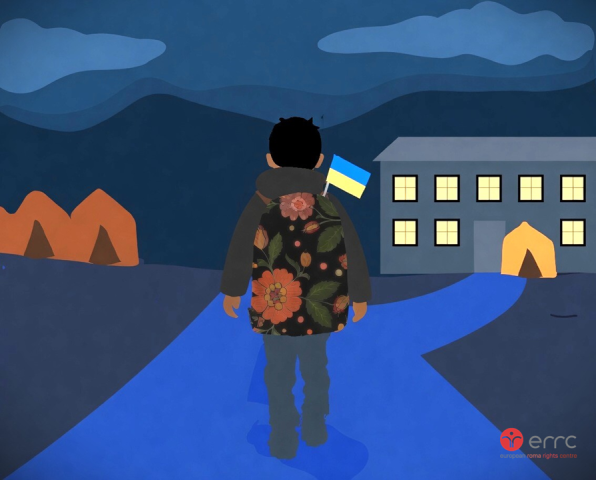
Brussels, 28 April 2026: The European Roma Rights Centre (ERRC) has filed formal complaints with the national ombudsman institutions in the Czech Republic, Hungary, Moldova, and Romania, alleging that Romani children fleeing the war in Ukraine are being systematically denied their right to education. The complaints highlight a pattern of discrimination where children face insurmountable barriers to schooling because of their ethnicity and their refugee status, leaving thousands of children in a state of educational limbo.
Despite the laws in all four countries guaranteeing free and non-discriminatory access to education for all children, the ERRC's findings reveal that Romani refugee children are disproportionately unable to access the school system. While official statistics often show high enrolment rates for Ukrainian refugees generally, these figures mask a stark reality: many Romani children are formally registered but never attend class due to complex needs. Many are pushed into inadequate online-only programs without necessary resources, or are outright refused entry due to language barriers, lack of documentation, and deep-seated antigypsyism.
"We are witnessing a second wave of exclusion," said Dorde Jovanovic, President of the ERRC. "While the world focused on the initial arrival of Ukrainian refugees, a silent crisis has developed for the most vulnerable among them. Behind every statistic is a child sitting at home, unable to learn because they don't speak the language well enough, lack a computer, or are too afraid of bullying to enter a classroom. We are filing these complaints because 'formal enrolment' is a lie if a child never even steps foot in a school. Look past the numbers and ask: why are Romani refugee children in these countries being systematically erased from the education system? This is not just an administrative glitch or policy failure; it is a violation of fundamental rights with intergenerational consequences."
Key Issues Across the Four Countries:
Hungary: The complaint alleges that despite a high theoretical enrolment rate, Romani refugee children face severe barriers including language rejection, placement in part-time programs, and a lack of targeted support. The ERRC notes that the Hungarian government's failure to collect disaggregated ethnic data renders the scale of exclusion invisible to policymakers. Furthermore, the historical legacy of segregating Romani children in "special schools" continues to influence the treatment of refugee children today.
Moldova: With nearly 150,000 Ukrainian refugees, Moldova faces a critical gap where 87% of refugee children remain outside the formal education system. The ERRC complaint highlights that Romani children are hit hardest by the language barrier (with many speaking Hungarian or Romani rather than Ukrainian), a lack of digital devices for online learning, and direct discrimination, citing a recent Equality Council ruling that found a school's refusal to enrol Romani children constituted direct discrimination.
Romania: Although over 23,000 Ukrainian children are enrolled, attendance rates are critically low, particularly among adolescents. The ERRC reports that Romani refugee children face racial discrimination from both authorities and fellow refugees. The complaint points to a "parallel educational reality" where children are registered but excluded from the protective environment of Romanian schools due to unstable housing, lack of integration support, and parental fears of bullying.
Czech Republic: While 92% of refugee households report school enrolment, the ERRC reveals that actual attendance among Romani children is significantly lower. Activists report that parents often enrol children merely to satisfy social protection requirements, knowing they cannot attend due to language barriers, lack of adaptation groups, and teacher unpreparedness. The complaint underscores the fragmentation of responsibilities between central and local governments, which leaves Romani refugees falling through the cracks.
Across all four nations, the ERRC identifies a consistent set of obstacles preventing effective access to education:
-
Data Blackouts: The refusal of authorities to collect disaggregated data on ethnicity prevents the monitoring of discrimination and the formulation of targeted policies.
-
Resource Deficits: A lack of devices, internet access, and school supplies disproportionately affects impoverished Romani families with additional needs.
-
Language and Integration Gaps: Insufficient language support and adaptation programs fail to accommodate children who speak Romani, Hungarian, or Russian, rather than Ukrainian.
-
Antigypsyism: Deep-rooted prejudice leads to bullying, segregation, and the active refusal of schools to accept Romani children.
The ERRC calls upon the national ombudsmen to launch immediate investigations into these violations. The complaints urge the authorities of the Czech Republic, Hungary, Moldova, and Romania to:
-
Establish robust monitoring mechanisms, including the collection of disaggregated ethnic data in compliance with human rights standards.
-
Deploy and fund Romani school mediators to bridge the gap between communities and schools.
-
Implement targeted outreach campaigns and provide material support (devices, transport, supplies) to vulnerable families.
-
Enforce strict anti-segregation measures and ensure that enrolment translates into genuine, regular attendance.
-
Strengthen cooperation with Romani civil society organisations to design and deliver effective inclusion programs.
“The right to education is the key to breaking the cycle of poverty and exclusion," Jovanovic added. "By failing to educate these children, these states are condemning a generation to the continued marginalisation in their adopted new home. We expect the ombudsman’s offices to treat these complaints with the urgency they deserve and to hold their respective governments accountable."
The ERRC will follow up with the relevant institutions and expects a formal response within the statutory timeframe.
The legal complaints are available here: Czech Republic, Hungary, Moldova, Romania.
For more information or to arrange an interview contact:
Jonathan Lee
Advocacy & Communications Director
European Roma Rights Centre
jonathan.lee@errc.org
+32 49 288 7679
Michal Zálešák
Legal Consultant
European Roma Rights Centre
michal.zalesak@errc.org
+421 90 550 2785