
After the pogrom: the harrowing impact of anti-Roma violence in a small Irish town
28 October 2026
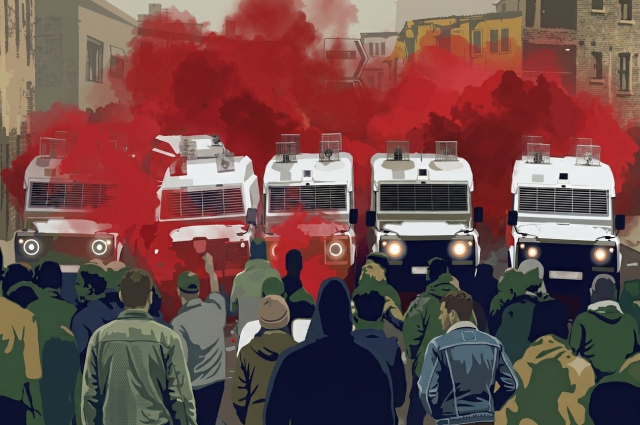
More than a year after the shocking outbreak of anti-Roma racist violence in the north of Ireland, a newly-published report reveals the traumatic impact the three days of mob terror had on minorities, children and young people.
In June 2025, a vicious anti-Roma pogrom broke out after news that that two 14-year-old Romanian youths had been charged with an alleged sexual assault on a teenage girl in Ballymena. In the violence that followed, described by the chief police constable as "absolutely race-motivated", homes, cars and businesses belonging to Roma were attacked with missiles and firebombed.
The report found that local schools were seen as a safe haven for children whose homes were under attack, however, statutory restrictions prevented one school from remaining open beyond 6pm, leaving them no option than to ask pupils to leave. Hotel accommodation was duly arranged by the school, and in what was described as “a damning indictment of institutional unpreparedness”, the school was forced to meet the hotel cost of sheltering some families out of its own budget during the pogrom.
Evidence gathered in the report Meeting, Mapping, Moving - Ballymena Recovering, found that 41 pupils from migrant backgrounds did not return to the school. As one teacher recounted:
“We never heard from 23 children ever again. 41 pupils in total never came back. Their belongings left in the classroom and not knowing what to do with them. Their names scribbled on the coat racks - do we let other children use them?”
For the other kids, the loss of classmates and friends was compounded by the fear and upheaval in their neighbourhoods. Young people described feeling unsafe and unheard, and many children from displaced families experienced nightmares months after the pogrom, with some parents keeping them away from school because they feared further attacks.
An Inter Ethnic Forum survey found that 76% of respondents had left Ballymena and, among those who left, 90% did not plan to return. They reported feelings of fear and intimidation. An estimated two-thirds of the pre-riot Roma population of 1,200 left the town in the immediate aftermath.
In November 2025, prosecutors citing "significant evidential developments" dropped charges against the two Romanian teenagers accused of sexual assault. As for the vigilante ‘defenders’ of women and children, The Detail reported that one third of those arrested in connection with the Ballymena riots had been the subject of a domestic abuse report, and one in seven of those arrested during the violent disorder has since been reported to the PSNI for domestic abuse.
Through in-depth community consultation, the report’s findings point to years of unheard concerns on living conditions and widespread deprivation; issues around housing, absentee landlords and overcrowding; and the lack of integration support and infrastructure to manage rapid demographic change. Meeting, Mapping, Moving noted that there was no effective mechanism to act on community intelligence or monitor rising tensions, and post-event trauma support was slow to begin. The report recommendations called on the authorities to address these deficits, and to provide accountable, co-ordinated political leadership to rebuild trust, monitor tensions, tackle disinformation, and improve standards across housing and public services.
Mainstreaming racism
Participants described to researchers how social media disinformation and outside actors intensified the disorder, while long-term residents and families who had built settled lives through work, school, and friendship experienced fear, intimidation, and displacement. As the academic Paul Reilly noted, loyalist groups like the Ballymena Reaction Group and Protestant Coalition used their public Facebook pages to share details of the protests and call for the removal of "Roma gang masters" from their communities: “Masked rioters went as far as to livestream themselves burning down a house in Ballymena, with one offering to smash a window in return for ‘gifts’ from viewers.”
Beyond fringe extremist groups, Reilly insisted that elected representatives need to acknowledge their role in mainstreaming racism by producing a toxic discourse in relation to immigrants, with some unionist politicians defending the “legitimate concerns of ordinary people over unchecked immigration”, and amplifying disinformation, loudly repeating the unfounded claim that Ballymena had become “a dumping ground” for migrants. At the height of the disturbances, DUP Communities Minister Gordon Lyons even revealed on Facebook that Romani families forced out of their homes in Ballymena were to be moved to LarneLeisure Centre. Soon after, the centre was attacked by masked gangs and set on fire.
While in the immediate aftermath of the riots, the Police Service of Northern Ireland (PSNI) claimed there was no evidence, subsequent reports point to a connection. One study found that such outbreaks followed a fairly familiar pattern, all taking place in areas where there is significant loyalist activity and feature a "degree of paramilitary control", with riots taking place during the summer coinciding with the loyalist marching season.
Another report commissioned in the wake of the violence noted that despite several decades since the Good Friday Agreement, there remain organised criminal structures and a variety of paramilitary groups operating across the province and including Ballymena. The report stressed the need to “acknowledge the muddy relationship that continues to exist between police and paramilitaries”, and described “concerns regarding child criminal exploitation, coercive community dynamics, and the mobilisation of young people by older actors (which) indicate that these vulnerabilities remain largely unresolved.”
The Independent Reporting Commission (IRC) in its 2025 annual report, said paramilitarism "continues to pose a threat" in Northern Ireland, and that "a particularly serious manifestation of that reality over the last two years has been the link between paramilitarism and racist violence connected to the issue of immigration.”