
Euphoria and After: the Test of Roma Inclusion in Post-Orbán Hungary
15 May 2026
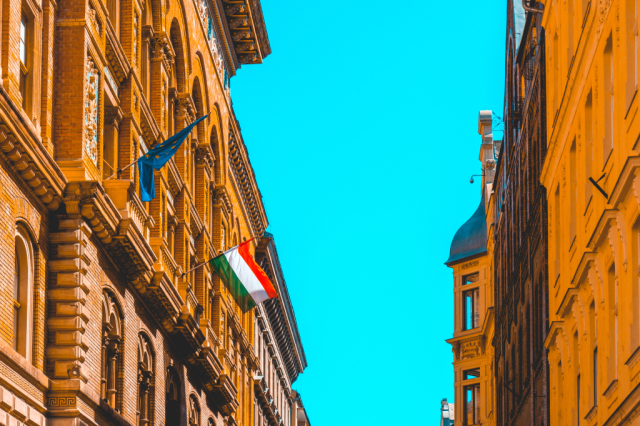
On a day, rich in symbolism, spectacle and celebration that marked the very end of the wretched Orbán regime, Hungary’s new prime minister, Péter Magyar promised last Saturday ‘to deliver justice’, and ensured that Romani citizens were at the very heart of the day’s events, as the EU flag was flown once again from the parliament building.
It was a day, when the Romani youngsters of the SUGO Tamburazenekar won the hearts of the nation. Straight after the Prime Minister’s inaugural address, they delivered an unforgettable performance in parliament of the unofficial Roma anthem Zöld az erdő. As the children gave it their all, six members of the neo-Nazi Mi Hazánk party stood up and hurriedly walked out. Their pathetic, mean-spirited stunt was condemned by Magyar as “a completely unacceptable act”, and provoked a backlash of scorn and contempt against the fascists across social media.
As the new MPs were sworn in, TISZA representatives István Gyöngyösi and Krisztián Köszegi took their oaths in the Romani and Beash languages respectively. They are two of four TISZA Roma MPs who won seats in the April election landslide; furthermore, Köszegi was nominated and elected as one of the vice-presidents of the Hungarian Parliament.
As the Tisza MPs moved out from the Parliament to the square where tens of thousands were gathered, the celebrations opened with a performance of Liszt's Hungarian Rhapsody No. 2, by the young award-winning Romani pianist and composer, Balázs Elemér.
One striking and recurring theme in the Prime Minister’s speech on Saturday was the need to overcome social exclusion, enhance child protection, and create equal opportunities. Magyar apologized to all those who had experienced “a state that did not protect or respect its citizens equally … (for) the missed opportunities of previous decades, for the humiliations inflicted by former pro-government politicians, for the reproduction of social exclusion, and for the fact that too many children in Hungary grew up with fewer opportunities in life simply because they were born elsewhere or into a different kind of family.”
In his stirring and heartfelt address to the nation, Magyar noted that his party had inherited a situation where the outgoing regime had prioritised enriching a narrow political and economic elite over its own citizens; where three million people live in poverty, and 400,000 children grew up in deprivation and social exclusion. Meanwhile, education, once imagined as a path to upward mobility, had become a tool for reproducing social inequality, where a child’s fate could be sealed at birth:
“It is a country where half of all adults try to live on less than 300,000 forints a month, while prices have spiralled out of control, housing has become an unaffordable luxury for young families, and child protection has often abandoned the most vulnerable.” He committed to creating a more just and humane Hungary “where our compatriots living in poverty will once again have a chance to rise.”
One of the most memorable scenes of the day, was the sight of thousands surging forward, as the cordons came down, to the steps of the parliament building, as Ibolya Oláh, an openly gay Romani singer, gave a powerful rendition of her song Magyarország – a song she once swore she would never perform again, because of the hate directed at her some years back. The symbolism was full-on, and the sight of lawmakers and citizens merging as one in the public square with this iconic tune as the backdrop, was genuinely moving.
Post-Euphoria, what’s it going to take to make the change?
It’s been a heady couple of weeks, since the historic election landslide that utterly vanquished the ruling Fidesz party. For many, the defeat of the regime in the April elections seemed as momentous as the last ‘system change’ from state socialism in 1990. Among the tens of thousands that spilled onto the streets of Budapest to celebrate the fall of Orbán on April 12 was the 75-year-old Methodist pastor Gábor Iványi, who was charged with gang violence against a state official in a politically-motivated show trial in February. Iványi posted on social media that he was experiencing “for the second time in my life, the euphoria of a regime change—the fall of a corrupt and inhumane regime.”
Péter Magyar’s victory dashed the illusion of the invincibility and inevitability of autocratic rule in an illiberal democracy. More than anything, he managed to communicate hope for a better future and the prospect of a system change. With his relentless on-the-ground electoral campaigning in towns and villages, and particularly deft use of social media to compensate for his exclusion from national TV channels, Magyar managed to take back the tricolour, to reclaim patriotism, and imbue it with a forward-looking verve and vision of a more humane Hungary, with shared expectations of fairness and accountability.
Those who have dissed the new intake as a bunch of ‘Fidesz-lite technocrats’ have completely missed the point. The contrast between the Tisza line-up of lawmakers and the outgoing motley crew of far-right Fidesz grifters and crooks could not be greater, and perhaps the best example is the new Minister for Education and Children’s Affairs, Judit Lannert, who yesterday promised, among other things, the rehabilitation of teachers fired for civil disobedience, the return of teachers' right to strike, and a review of the National Education Act.
When Péter Magyar first announced her nomination on April 24, right-wing media described her as “taking education in a rainbow, left-liberal direction”, and Fidesz ideologue Balázs Orbán described her as one of the “most committed education experts with extremely radical, left-liberal views, who support the causes of Ukraine, the gay and gender lobby, and the freeFSZE movement in every respect.” According to the Hungarian Conservative “what got her the most backlash is her use of the rainbow-coloured circle around her face on her social media profile to show solidarity for the LGBTQ community in Hungary in June 2021.”
At her ministerial committee hearing in parliament on Monday May 11, Lannert, an economist and sociologist by training, who has been involved in educational research since the change of regime, and has long been a critic of racial segregation, stated that she envisions the new education policy as a child-centered, data-driven ministry that works in partnership with professional organizations:
"In the autumn, we will initiate a dialogue with schools so that we can develop common minimums around the major issues of learning and education, taking into account the opinions of teachers, support professionals, parents, and students.”
She has been explicit that transforming the education system is not just an institutional or regulatory issue, but requires a new, shared narrative and a ‘mental revolution’, where efforts for equal opportunities and integration should not be interpreted as sacrifices, but as a common interest.
This appointment is a declaration of intent. While the new PM may be politically positioned right of centre, it is apparent that Magyar’s own vision of social justice has been transformed by the months of intense campaigning that saw him visit hundreds of cities, towns, villages, shake hands, and meet with tens of thousands, including the poorest and most marginalised of Hungary’s citizens.
In his address to the nation last Saturday, Magyar apologised to the victims of abuse at the Bicske children’s home and a young offenders’ institution in Budapest’s Szolo Street, noting that “the children are still suffering today and the adults still carry the scars of abuse and neglect which the Hungarian state failed to prevent.” He said the victims were “not alone”, and Hungary “will no longer look the other way”. The state, he stressed, had a duty to protect the children in its care, adding that this was a duty that allowed no delay, excuses or political evasion.
The desire to restart dialogue between government and civil society was made abundantly clear, when he apologised to the civilians, teachers, journalists, health-care workers, and public figures “who were stigmatised, vilified, or treated as enemies simply because they dared to speak out, dared to stand up for the disadvantaged, voiced criticism, or simply held a different opinion.”
The cost of corruption and cronyism had been borne not by the elite but by the entire nation, but the gravest sin of the past years had been “turning Hungarians against each other”, by cynically stoking division through “hatred, fear and constant incitement.” The politics of the outgoing regime had “poisoned the soul of an entire nation.” That era ended for good on April 12, he said, calling for the “enormous task of reuniting the nation to begin now”. On a day where the symbolism made it abundantly clear that Roma communities are an integral part of the nation, Magyar promised that “Hungary can still become a just and humane home for all of us.”
As Magyar told the New Yorker, the dance is just beginning, “there is a honeymoon feeling in the country and the honeymoon could go away very, very quickly.” Now comes the hard part, governing, holding a coalition together and delivering on election promises. But this incoming administration has hit the ground running, and perhaps this time, all Hungarians, Roma and non-Roma alike, will get the democracy that they truly deserve.