
From Minneapolis to Teplice: How George Floyd and Stanislav Tomáš Exposed Police Racism
20 July 2026
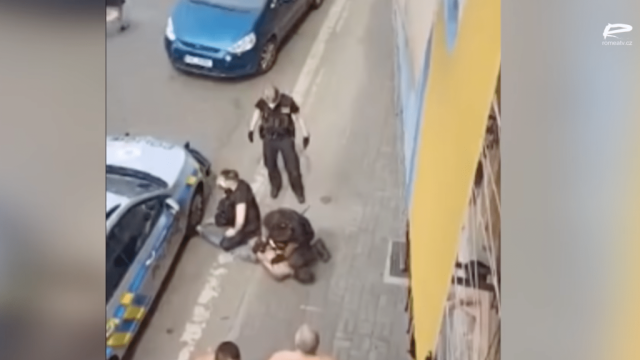
On 19 June 2021, three Czech police officers were caught on video restraining Romani man Stanislav Tomáš on the ground. One appeared to be holding his feet, another knelt on his neck for several minutes, while the third handcuffed him. The victim could be heard screaming as he writhed on the ground before going limp and silent under the police officer's knee.
At no point did any of the officers intervene, check his pulse, or render medical aid. By the time the paramedics arrived, he was already dead. The autopsy showed he had died of a heart attack brought on by an overdose; activists and his family argued that pinning him to the ground for 11 minutes in prone position, with a knee to the back of his neck for four minutes, while he needed medical attention contributed to his ultimate death. Five years later, the European Court of Human Rights has finally vindicated his surviving sister (S.T) in her case against the Czech state.
On July 16, the Court held that disproportionate force was used, and that all of these forms of force – handcuffing, prone position and kneeling on the upper back, shoulder blades and neck area – were simultaneously used against Tomáš for over four minutes. Further, that the police officers kept the victim in a vulnerable situation in a potentially lethal position without monitoring his health sufficiently to realise he had lost consciousness while under their control. Thus, the Court concluded that the State failed to uphold its positive obligation to provide adequate medical assistance to a person under its agents' control. Furthermore, the Court concluded that the authorities failed to demonstrate that they took all reasonable steps to uncover any racist motive behind the police intervention. Finally, after years of obfuscation, inept and biased inquiries, the official Czech state account of this police murder has been revealed as a tissue of lies.
'No Czech Floyd'
As the video of the incident went viral across social media, the uncanny similarities to the police murder of George Floyd in Minneapolis in the United States in 2020, were plain to see. An officer had knelt on Floyd's neck for over nine minutes while he was being held in a prone position with his hands cuffed behind his back. Bystander video of the encounter quickly went viral sparking mass protests against police racism across the USA and beyond.
Yet despite the uncanny parallels, Czech authorities moved quickly to erase the comparison. The Czech Criminal Police hastily put out a statement on its official Twitter account stating:
"No 'Czech Floyd'. The intervention against a multiple repeat offender who, under the influence of drugs, had been vandalising cars in his neighbourhood and disregarding police orders, was conducted in accordance with the law and had no connection to the deceased's death. A forensic autopsy confirmed this."
In addition to the shocking similarities in the very mechanism of murder, the besmirching of both victims' characters followed a well-trodden path. When it came to trial in the US, the police defence lawyers chose "to ruthlessly smear George Floyd's character", to view Floyd as a fentanyl addict, who died not because of police action, but because of drugs in his system, or his hypertension and enlarged heart. The first police report Minneapolis Police media relations office gave of Floyd's death stated "Man Dies After Medical Incident During Police Interaction," and that officers responded to, "a report of a forgery in progress. Officers were advised that the suspect was sitting on top of a blue car and appeared to be under the influence."
On June 21, two days after the killing of Tomáš, the Czech Criminal Police issued a public statement on its website:
"The autopsy of the deceased ruled out any connection with the intervention that preceded the arrest. According to the preliminary autopsy report, the man was found to have been under the influence of an amphetamine-type foreign substance, and pathological changes to the coronary arteries of the heart were found."
The Interior Minister, Jan Hamáček immediately weighed in same day to give his full support to the police via his Twitter account, "Anybody under the influence of addictive substances who breaks the law has to count on the police intervening. It is mainly thanks to the work of policemen and policewomen that we are among the top 10 safest countries in the world."
On 23 June 2021 the Prime Minister, Andrej Babiš, posted the following statement on his official Facebook page: "If someone destroys cars, is aggressive and even bites a police officer, he or she can't expect to be treated with kid gloves. Besides, the forensic autopsy clearly proved that he did not die because of the police intervention. It is sad, but it is also unlikely that a normal decent person would get into a similar situation. I thank the Teplice police officers for their work, they did not have it easy."
The Crucial Difference
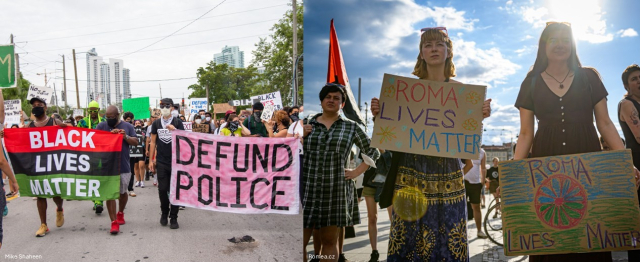
Such striking similarities surrounding both men's murders and the immediate aftermath, render the differences especially stark. One big difference is that the death of George Floyd spurred nationwide protests against police brutality and hastened a wider public reckoning over anti-Black racism. Another crucial difference lay in the delivery of justice: Police officer Chauvin and his three colleagues involved in Mr. Floyd's death, were fired and charged with a variety of crimes. Before the trial, the city of Minneapolis reached a $27m settlement with the family of George Floyd. Less than a year after the murder, Chauvin was convicted of murder in April 2021 and was sentenced to 22 and a half years in prison. In July 2021, the other three officers were each sentenced to several years in prison. From a time when there was a semblance of dignity in the Oval Office, President Biden praised the verdict in a nationwide address, calling it a “too rare” step to deliver “basic accountability” for Black Americans.
Beyond a few scattered rallies attended largely by Roma themselves, there were no mass protests for Stanislav Tomáš across Europe, no corresponding chants by the continent's progressives that “Roma lives matter”, and no challenge to the systemic police racism that still takes a deadly toll. What followed was institutional cover-ups, denial of any responsibility on the part of police officers, persistent official neglect of any evidence that contradicted the police account, and the dismissal of all of the efforts by Tomáš's sister in pursuit of justice.
The Tortuous Road to Strasbourg
The eventual exhaustion of all domestic remedies in the Czech Republic, by S.T. and lawyers from the ERRC and FORUM, led to the European Court. What follows below is an abbreviated timeline of the appeals and submissions, and the repeated denials of justice, and instances of institutional obstruction along the road to Strasbourg:
Phase 1: Immediate Denial (July 2021)
8-9 July 2021: The police training department of the Regional Police Directorate of the Ústí nad Labem Region issued a statement for the purposes of the criminal investigation according to which the police intervention had been fully in line with the law and internal regulations. The following day, the Department of Public Order Police of the Regional Police Directorate of the Ústí nad Labem Region issued a statement concluding that that the police intervention had complied with the applicable legislation in relation to the use of coercive measures and weapons, and that "the police officers had used the least amount of force possible and had used the handcuffs for the shortest possible time."
12 July 2021: The Criminal Police rejected S. T’s request for a second autopsy by a neutral party. It considered that no new facts had been uncovered that would require it.
21 July 2021: The Ústí nad Labem Regional Prosecutor's Office upheld the police's decision.
Phase 2: Investigation Obstruction (October 2021 – Early 2022)
19 October 2021: The forensic medical expert opinion published by the Criminal Police concluded that death had been caused by methamphetamine intoxication. It considered that Stanislav Tomáš had not been knelt on in the neck area, and that no causal link could be established between the police intervention and his death. The experts further considered that his death could only have been prevented if he "had not indulged in methamphetamine".
13 December 2021: The Czech Deputy Public Defender of Rights' report found the police responsible for playing a significant role in the death of the Romani man. Her report stated that the police officers made three major errors: first, they waited up to three minutes before calling an ambulance upon arriving on the scene, and none of the officers monitored Mr Tomáš physical state during the arrest. Second, they failed to ascertain in a timely fashion that the victim had stopped displaying signs of life; and third, they failed to remove his handcuffs and did not begin to immediately resuscitate Stanislav Tomáš when he collapsed.
In addition, she found that the Regional Police Directorate did not fully investigate the facts, and neglected to include any statements from the crew of the first emergency rescue vehicle at the scene. The paramedics' accounts were especially important as they contradicted police assertions that Stanislav Tomáš did not collapse until he was inside the ambulance. Deputy Public Defender of Rights quoted one paramedic's testimony which irrefutably contradicts the police account:
"(The patient's) hands were cuffed behind his back. The officers were pinning him to the ground just by one arm so that he wouldn't run away. When I approached the patient, I ascertained that he was lying on his abdomen, making no noise, and I checked his carotid artery, but no pulse could be felt. At that moment the patient's circulatory system had stopped, i.e., he was not breathing. Subsequently I insisted he immediately be placed on a stretcher and put into the ambulance."
Ms. Šimůnková's report found that the errors committed during the internal investigation, which included "absolutely ignoring the absence of testimony" from the paramedic crew – could lead to the requirements of an effective investigation not being met.
Phase 3: Appeals Dismissal (2022-2023)
31 January 2022: The Regional Prosecutor dismissed a complaint lodged by S.T., where she argued that the investigation had been conducted improperly, that the use of force had been disproportionate, and that the police officers had failed to adequately monitor his health and had not called the ambulance in a timely manner. She further submitted that the evidence had not been thoroughly assessed, as the Criminal Police had uncritically accepted the police officers' version of events and ignored the contradicting statements of the paramedics. In its dismissal, the Regional Prosecutor argued that since the investigation had refuted that the officer had knelt on Tomáš's neck, or that his death had occurred during the police intervention or in any causal link with it, "it was futile to establish whether Tomáš had been alive when the ambulance had arrived. His death would have occurred in any event."
11 February 2022: The General Inspection of Security Forces (GIBS in Czech) concluded its preliminary inquiry by finding that there had been no suspicion of a criminal offence or other unlawful conduct by the intervening officers. The file was closed without taking further action. The GIBS concluded that "the intervening police officers had treated Tomáš gently and calmly. It further considered that the evidence collected by the Criminal Police had indicated that none of the police officers had knelt on Tomáš's neck or otherwise acted in such a way that would have obstructed his airway."
3 March 2022: The High Prosecutor dismissed S.T.'s request for a review against the Regional Prosecutor's dismissal, holding that no irregularities had been found, all objections had already been duly addressed and reaffirmed the Regional Prosecutor's conclusions.
9 May 2022: The applicant lodged a constitutional appeal against the Criminal Police and GIBS decisions, and their subsequent reviews by the Regional and High Prosecutors. She complained that the police had violated her brother's right to life. She argued that the police intervention had been excessive considering the victim's vulnerable state owing to his intoxication and visible injuries, of which the police officers had demonstrably been aware; that the officers had failed to monitor his health, promptly call the ambulance and provide first aid; and that the continuous restraint of Tomáš with handcuffs had clearly been excessive given his loss of consciousness and lack of resistance.
26 July 2022: The High Prosecutor rejected a further request as ill-founded, finding no fault either in the procedure followed by the GIBS or in the review conducted by the Regional Prosecutor. The High Prosecutor held that the forensic medicine expert opinion had unequivocally showed that Tomáš's death had not been linked to the police intervention.
21 March 2023: The Constitutional Court dismissed S.T.'s constitutional appeal as manifestly ill-founded, and lastly concluded that the authorities had sufficiently investigated the police officers' potential discriminatory motives.
10 August 2023: Following the dismissal of the organisations' constitutional appeal, human rights lawyers from the ERRC and the Forum for Human Rights (FORUM) filed a case before the European Court of Human Rights against the Czech Republic for the death of Romani man Stanislav Tomáš in police custody in Teplice in 2021.
Phase 4: European Court Victory (July 2026)
16 July 2026: In the Strasbourg court, we witnessed the first glimmers of justice for Stanislav Tomáš, and his sister. The Court was in no doubt that her brother's death caused the applicant considerable suffering and awarded her EUR 20,000 in respect of non-pecuniary damage. A further EUR 10,660 was awarded in respect of costs and expenses.
The Court found a violation of Article 2 of the Convention in its substantive aspect in respect of Tomáš's death; a violation of Article 3 of the Convention in respect of the disproportionate use of force during the intervention; and a violation of Articles 2 and 3 of the Convention in respect of the authorities' failure to effectively investigate the incident.
It was also significant that the Court found there had been a violation of Article 14 in conjunction with Articles 2 and 3 of the Convention on account of the authorities' failure to take all reasonable steps to unmask any potential racist motive. The Court was of the opinion that the combination of contextual elements and reasonable inferences – “the combined indicators” – were sufficient to alert the authorities to the possibility that racial bias may have played a role in the intervention, and as a consequence, the State was under a duty to take all reasonable steps to investigate any potential racist motive. Instead, "the authorities made no attempt to explore the possibility that institutional racism could have influenced the police officers' conduct."
A Courageous Ruling
The ruling carries symbolic weight beyond compensation. It corrects a racist narrative and smear campaign delivered by every level of the Czech criminal legal system, as well as prominent politicians and national media. The ERRC’s President, Đorđe Jovanović, described the Court as showing “remarkable courage in making this decision, particularly in its finding on institutional racism.”
"This wasn't a safe ruling” said Jovanović, “it went against years of official denial and would have been easier to just sidestep. The ERRC and FORUM stood with this case from the very beginning, and later, when the momentum had faded and most others had moved on because it was no longer fashionable, we still persevered because justice doesn't expire with the news cycle. Managing this case was extraordinarily difficult – not just because of the legal complexities, but because of the sustained public attention and interference from outside actors who did not have the applicant's best interests at heart. We were constantly navigating between competing narratives, all while trying to support Stanislav’s sister in seeking accountability for her brother's death. This ruling is hers, not ours. It takes a lot of bravery and strength to continue fighting for justice with a case like this."