
Hague prosecution claims ‘overwhelming evidence’ of war crimes against Serb and Roma civilians by former Kosovo president
13 February 2026
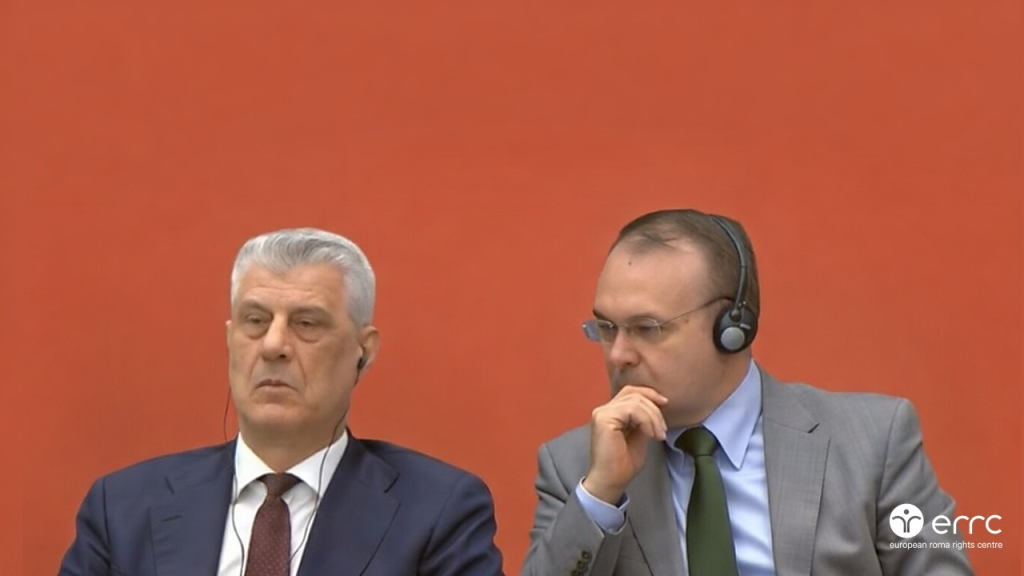
Prosecuting lawyers at the Kosovo Specialist Chambers in The Hague, called for 45 years’ imprisonment for Kosovo President Hashim Thaci and three other Kosovo Liberation Army (KLA) commanders, for crimes against Serb and Romani civilians.
The indictment accused the defendants of partaking in a joint criminal enterprise that “conducted a campaign of persecution against opponents” between March 1998 and September 1999. These ‘opponents’ included political rivals and “persons of Serb, Roma, and other ethnicities”. Chief prosecutor Kimberly West stated: “These crimes are war crimes and crimes against humanity and are grave in nature. And the gravity of the charges has not diminished with the passage of time.”
Referring to one of the accused, KLA spokesman Krasniqi, the prosecution cited as evidence “communiques calling for the killing of collaborators, regulations that codified merciless treatment, appointments of those advancing the criminal objectives to higher echelons of responsibility, decisions to take and execute Serb civilians”.
1999: Retribution, collective punishment, and crimes against humanity
Whatever the verdict, and whether or not the court delivers justice, there will be bitter recriminations, and zero reconciliation. However, the trial has, at the very least, provides a reminder that Roma were also targeted for violence alongside Serbs. It has also provided an opportunity to recall the historical failure of UN and NATO armed forces to protect minority civilians from a coordinated KLA terror onslaught.
Following the NATO deployment of the Kosovo Force (KFOR) on 10 June 1999, the vast majority of the over 800,000 Albanian refugees returned to Kosovo in a few days, described by Tim Judah as “the quickest and biggest refugee return in modern history, and also the quickest role reversal,” where the victimized quickly became the victimizers. As reported by the ERRC, even when it became obvious that most of the revenge was being systematically executed by KLA soldiers with the specific intent to expel non-Albanians from Kosovo (including Roma, Ashkali and Egyptians), it was widely portrayed as an ‘inevitable’ form of vigilantism.
The period from June through September 1999 was marked by murders, kidnappings, rapes and beatings of Roma, Ashkali, and Egyptians, as well as the looting and burning of thousands of their homes. In some cases, these acts of violence were followed by the departure of the communities. Numerous killings of Roma by ethnic Albanians occurred immediately after the NATO deployment in the region. ERRC research in this period recorded murders, abductions and disappearances of Roma throughout the province, as well as widespread expulsions, and looting and destruction of homes. Human Rights Watch also reported that Roma were driven from their homes in Pristina and elsewhere by intimidation and harassment, with grenade and rocket attacks on minority homes being one favoured method of ‘persuading’ residents to leave.
According to Human Rights Watch, NATO failed to take decisive action to curb the forced displacement and killings of Kosovo's minorities in the first months. This failure created a culture of impunity for such violence, and in its 2001 report, HRW stated: “Senior NATO and U.N. officials are well aware that persons linked to the former KLA and the KLA's successor, the Kosovo Protection Corps are implicated in violence against minorities and in criminal activities, but have chosen to do little about it.”
It has been estimated that more than 100,000 Roma, Ashkali and Egyptians were forcibly displaced or fled Kosovo. As many as 50,000 Roma, Ashkali and Egyptians found refuge in Serbia, tens of thousands more tried to reach Western Europe and thousands took refuge in Montenegro, Macedonia and Bosnia and Herzegovina.
A verdict awaits
Prosecutor Kimberly West told judges that witnesses and victims “so yearned for the truth to come out” that they were willing to risk a “climate of intimidation” to testify at the Kosovo Specialist Chambers, which is based in the Netherlands but is part of Kosovo’s legal system. Due to a history of witness intimidation, many prosecution witnesses have testified behind closed doors to protect their identities due to fears of reprisals.
During closing statements on Tuesday, the prosecutors insisted the defendants had command responsibility for crimes committed by the KLA fighters; and that they themselves had often witnessed or participated in such crimes. The defence has maintained that the KLA did not have a proper command structure, and that “the accused did not have the authority to hold the guerrilla fighters accountable as real power in the KLA was held by operational zone commanders.”
As Balkan Insight reported, the prosecution’s call for 45 years’ imprisonment for each of the defendants was widely condemned in Kosovo. In a Facebook post, President Vjosa Osmani said attempts to equalise the war of the KLA with the crimes committed by Serbian forces were unjust: “Kosovo and its citizens want justice. The war of the KLA was righteous and pure.” After the final closing statements on February 18, the judges’ panel has 90 days to consider its verdict, which means it may be delivered sometime in May.
Cover photo: Hashim Thaci (L) and Rexhep Selimi (R), Kosovo Specialist Chambers in The Hague, 9th February 2026. Kosovo Specialist Chambers Livestream