
Hungary Proscribes ‘Antifa’ as a Terrorist Organisation and Removes 12 Years of Roma Rights Reports
20 December 2025

By Judit Ignácz
Around the world, political leaders are increasingly reading from the same authoritarian playbook. They limit media freedom, question the legitimacy of institutions, divide societies, criminalise opposition, and turn crises into opportunities for political gain. Hungary has now taken another clear step in this direction.
At the end of September 2025, the Hungarian government officially labelled the antifascism movement - ‘Antifa’ - a terrorist organisation. The move clearly follows Donald Trump's earlier attempt in the United States. Just days later, 12 years of Roma-related human rights reports disappeared from the website of the Office of the Commissioner for Fundamental Rights (AJBH). These actions show a growing, deliberate effort to increase state control over dissent, remove accountability, weaken checks and balances, limit human rights, and erode the mechanisms designed to hold power to account.
Monkey see, Monkey do
On September 22, 2025, President Donald Trump signed an executive order declaring Antifa, the anti-fascist movement, a domestic terrorist organisation. Trump ordered Federal agencies to dismantle Antifa and its affiliated networks, target their funding, and he called them a violent “militarist, anarchist enterprise” that allegedly wants to overthrow the U.S. government.
Four days later, on September 26, 2025, the Hungarian government published a government decree in its official gazette, labelling Antifa as a terrorist organisation. Prime Minister Viktor Orbán proudly linked his decision to Trump, saying, “We will follow the American model.” Moreover, Hungary’s Minister of Foreign Affairs and Trade, Péter Szijjártó, even suggested an initiative to list Antifa as a terrorist organisation across the entire European Union.
In Hungary, just like in the U.S., ‘Antifa’ is not a single organisation that can be proscribed. It has no central leadership, no official membership, and no organisational structure that could be legally designated a “terrorist organisation.” Simply put, there is no entity named ‘Antifa’ in existence in Hungary which can be specifically labelled a terrorist organisation. This gives the Hungarian government the power and broad opportunities to decide to investigate, monitor, freeze assets, and restrict the movement of individuals only based on ideological affiliation and belief.
For years, antifascists have been one of the counterweights to the Hungarian state, counter-demonstrating at neo-fascist and neo-Nazi events and pushing back against the rise of extremist ideologies that have put marginalised and racialised groups at risk, particularly Romani people in Hungary. Indeed, Roma have themselves taken active roles in such actions: turning up to protect their neighbourhoods from fascist marches, such as in 2022 when nearly a thousand turned out to oppose neo-Nazi paramilitaries led by the far-right Mi Hazánk party in Nyíregyháza.
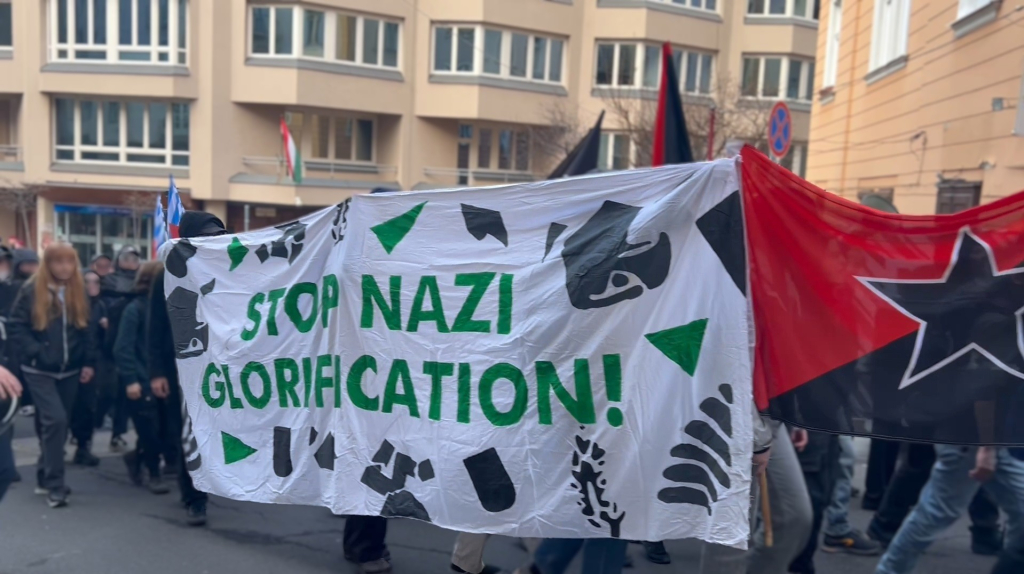
(Photo: Antifascists stage a counter protest against the neo-Nazi ‘Day of Honour’ gathering, which commemorates the SS and Hungarian soldiers who died attempting to break the Soviet siege of Buda Castle in 1945 | 8 February 2020)
The Vanishing of Roma Rights Monitoring
Only weeks after the Antifa decree, in November 2025, Hungary’s Office of the Commissioner for Fundamental Rights (AJBH) deleted from its website 12 years of reports of its former Deputy Ombudsperson for Minority Rights, Szalayné Sándor Erzsébet. The reports exposed widespread segregation of Romani children in church-run schools, exclusionary local “identity” laws limiting the mobility of Romani people, and other structural injustices faced by Romani communities in the country.
They were among the few remaining sources of official documentation of Roma rights violations in the country. AJBH explained that the reports were removed because they had been produced under older procedural rules and did not meet the stricter guidelines of the reorganised office. They said only older, compliant documents will eventually be re-published. However, for now, as if by magic, a detailed archive covering more than a decade of anti-Roma racism and discrimination has disappeared overnight.
Is Neo-Fascism on the Rise in Hungary?
Orban’s past moves, just as Mussolini’s Italy and Hitler’s Nazi Germany, reflect some core features of fascism, such as the criminalisation of dissent, systematic attacks on the rule of law, hostility toward independent institutions and civil society, and increased state control over media and education. These steps are combined with openly homophobic, transphobic, xenophobic, chauvinistic, and anti-Roma narratives that clearly define who is perceived to belong and who does not to the Hungarian society.
For Romani people, neo-fascist politics mean scapegoating, criminalisation, poverty blaming, segregation, surveillance, harsher policing, decreased access to basic social services, and increased threats to physical safety due to the tolerance of far-right extremist groups. This leads to not only the normalisation of hate speech, but also political violence and attacks on minorities, including Roma, LGBTQIA+ people, immigrants, and others living at the intersection of multiple forms of exclusion.
Criminalising Dissent
Orbán has long blacklisted NGOs and activists, targeted the media, and limited freedom of assembly and association in a country that is a regular home to several international neo-Nazi events (with a consistent presence of antifascist counter-protests). Labelling anti-fascist action as a terrorist organisation allows the government to expand the definition of “terrorism” far beyond violence. Individuals who have never committed a crime can suddenly become a security risk if they challenge or critique the government. Someone attending a demonstration, making political art, or sharing antifascist ideas online may be treated as a threat. This creates a powerful tool for the state to monitor, restrict, and criminalise people based purely on their political identity, group membership, or activism, namely for who they are perceived to be and what they believe. This step is a tool to delegitimise left-wing protest. It is intended to allow the labelling of political opposition as a threat to national security and leads to people fearing the consequences of speaking up.
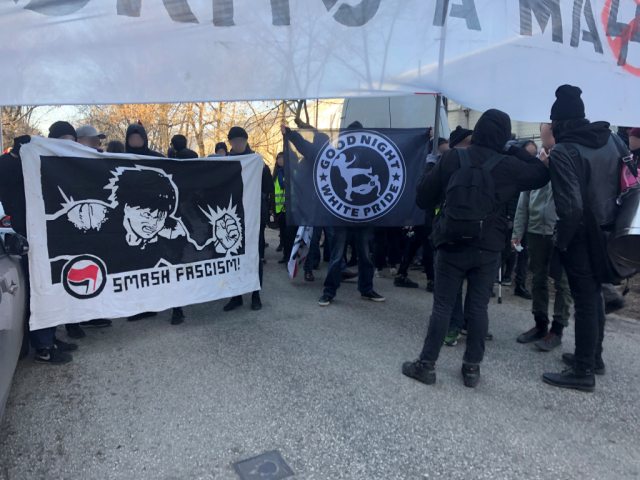
(Photo: Antifascist counterprotest against the neo-Nazi ‘Day of Honour’ at Buda Castle, Budapest | 8 February 2020)
Erasing Accountability
Ombudsperson’s reports must be transparent, reliable, and publicly accessible. Removing records on Roma rights violations deletes evidence of structural racism and rights violations against Romani people in Hungary. This actively absolves the state of its liability and weakens the institutions meant to hold it accountable. The state’s 2021 decision to merge the Equal Treatment Authority into the Office of the Commissioner for Fundamental Rights (AJBH) has already raised serious concerns about the independence and reliability of human rights reporting and monitoring mechanisms within the Hungarian state institution. This further erosion of the role of equality monitoring in Hungary is perhaps the final nail in the coffin.
Inciting Hatred
Orban also reinforces repression through his own rhetoric. In a speech in 2020 regarding legal action against school segregation in Gyöngyöspata, he incited hatred against Romani people and intentionally attacked counter voices and institutions: “The question is whether Hungarians can feel at home in their own country. Is this a country where a minority can regularly impose its will on the majority? It cannot be that the majority feel alien in their own country. As long as I am the Prime Minister, this will not happen. This is, after all, the country of the natives, our country. Organizations like George Soros's initiated this.” In a 2022 speech, he doubled down on his biological racism by referring to the purity of the Hungarian nation, he said: “This is why we have always fought…we do not want to become a people of mixed race.”
The playbook and methods are the same, and they are spreading internationally. History shows that neo-fascism targets the most vulnerable first, starting with rhetoric, escalating through laws and institutions, and eventually leading to violence. While marginalised communities suffer the earliest and harshest consequences, this form of politics ultimately destroys democracy, exploits fear to accumulate power and control, and in the end makes it harder for everyone to demand justice.
This is why silence is not neutrality but compliance. Hungarians who believe in freedom should clearly act in solidarity with the antifascist resistance and stand against a government that normalises exclusion and hatred. History has shown us many times that fascism never stops at its first targets, and those who think they are safe will eventually be next. Therefore, opposing fascist ideologies and actions early and collectively is not extremism. It is a civic responsibility.
(Cover photo: police perform an ID check on an antifascist protestor during an anti-Netanyahu rally at Széll Kálmán tér in Budapest | April 2025)