
Never again! Never forget the Romani victims of neo-Nazi terror in Hungary
23 February 2026
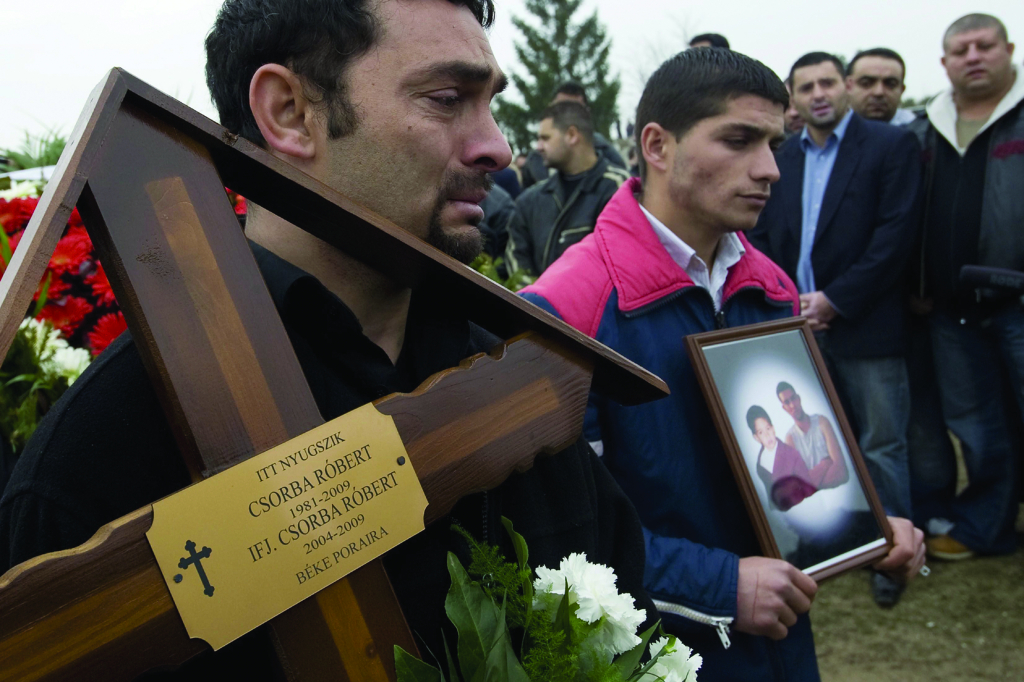
February 23rd marks the 17th anniversary of the murders of five-year-old Robika Csorba and his father Robert, victims of a murderous series of attacks on Romani communities across Hungary in 2008 and 2009. Six Roma were slain and over 50 others wounded in the 14-month wave of far-right terror, which left the maimed and the bereaved severely traumatized.
The Romani movement in Hungary proposed that February 23rd become an official memorial-day to honour the victims of the neo-Nazi wave of terror against Romani people. The Budapest municipality, and three districts in the city have already adopted this proposal. National recognition is still pending. The mayor of Budapest, Gergely Karácsony, opened a photo exhibition titled Do Not Open in the City Park on Monday afternoon in memory of the victims.
The wave of terrorist attacks
After midnight on 23rd February 2009, in the village of Tatárszentgyörgy, attackers first threw Molotov cocktails, setting the Csorba family home ablaze. On hearing the bangs, Robert grabbed his two eldest children, while his partner took the youngest child Maté. As Robert fled the burning house, holding Robika close to his chest and Bianka by his side, a waiting gunman opened fire hitting all three. Only Bianka would survive.
His grandmother said, “I was holding Robi’s head in my lap, and he kept saying ‘le, le, le’ meaning he was shot but he couldn’t get the whole word out. My little grandson was gasping with his eyes closed. With tears rolling down his face. Putting so many shots into such a small child barely 11 kilos. May their lungs dry up.”
This appalling murder occurred against a backdrop of widespread anti-Roma sentiment, increasing intimidation fuelled by prejudiced media reporting, and racist rallies by the far right Jobbik party and its uniformed paramilitaries. Tension had been especially high following the killing of the Romanian handball player Marian Cozma in Veszprém on February 8. At the memorial for Cozma there were cries of “death to Gypsies!” even before police announced that two of the suspects in the attack were Roma.
Just a few months before the attack on the Csorba family in 2009, there had been another double murder, where a family home in the village of Nagycsécs had been firebombed and the victims shot as they fled their burning house. Tibor Nagy was wounded – his wife Éva and his brother Jozsef died in the gunfire.
The police proved to be both racist and incompetent in their investigation, they refused to recognise and failed to investigate the possibility that the attacks were linked and racially motivated. When they arrived at the scene of the Csorba double murder, they even denied a crime had taken place. They issued a statement later that morning saying “the fire in Tatárszentgyörgy, in which two people had died, had been caused by a short-circuit.” The police had to be called back to the scene because the family found footprints and spent cartridges in the bloodstained snow. So careless were they that one police officer even pissed on a footprint.
Only after Viktória Mohácsi, a Romani Member of the European Parliament, arrived and called in the National Investigation Bureau, was this incident acknowledged as a double homicide. An on-site fact-finding mission by human rights groups including ERRC found the conduct of the police, paramedics, and firefighters to have been criminally negligent, and the rights groups demanded that the police investigate the likelihood that this double murder was a racist hate crime.
The attacks against Roma continued, and in May 2009, Jenő Kóka was gunned down as he left home for his nightshift in a local factory in Tiszalök. The far-right paramilitary Magyar Gárda had staged mass meetings and marches in both Tiszalök and Tatárszentgyörgy prior to these fatal attacks. The speeches were full of anti-Roma racism and threats of violence. The police and media had previously speculated these attacks were carried out by loan sharks, jealous lovers, or feuding families, instead of investigating known violent far right extremists. Finally, after Jenő’s assassination, the police conceded that the atrocities were likely linked and carried out by a four-man cell with military expertise.
However, they failed to apprehend the killers and to prevent the final assault in August 2009, when gunmen smashed their way into the home of Maria Balogh in the village of Kisléta, murdered her in her bed, and seriously wounded her 13-year-old daughter Ketrin. On 21 August 2009, police arrested four perpetrators.
In August 2013, life sentences were handed down to three of the killers. The fourth defendant received a 13-year prison sentence. Following the verdict, Romani activist Horváth Aladár called the trial infrastructure ‘third-rate’ and complained that the court had largely neglected to address the issues of the defendants' political motivations, and the shared culpability of the authorities as a result of their botched investigations. There was widespread disquiet at the failure to establish how the defendants managed to find funds and train for the killings, and carry out attacks while remaining undetected for so long.
The persistence of anti-Roma racism
What was especially chilling at the times of the arrest and later convictions of the neo-Nazi killers, was the lack of public sympathy and solidarity with the Romani victims and community. In fact, anti-Roma hate speech continued unabated, without any regard for consequence.
The far-right publicist Zsolt Bayer wrote in a daily newspaper in 2013, that “a huge number of Gypsies have given up on coexistence and given up on their humanity.” He would later call for a final solution: “One must retaliate rather than tolerate. These animals shouldn’t be allowed to exist. In no way. That needs to be solved — immediately and regardless of the method.” Bayer is a close friend of Prime Minister Viktor Orbán and a founding member of the ruling Fidesz party, and in 2016 the government awarded him the Order of Merit “as a recognition of his exemplary journalistic work” – a move that prompted much outrage.
The murderous wave of violence that was visited upon Roma in Hungary just 17 years ago, was a shock reminder of the extent to which racist hate speech and scapegoating of ethnic minorities can incite lethal racist violence.
As Hungary prepares to go to the polls in April, political leaders who indulge in anti-Roma rhetoric for short term electoral gain stand accused. As do all politicians and public figures who fail to condemn, or even tacitly condone acts of violence and intimidation against Roma. Not only do such people dishonour the dead, but by virtue of their collusion, they imperil the living. Public ‘forgetfulness’ about the racist murders of Roma in 2009, and the persistence of anti-Roma racism in Hungary, strongly suggests that a national reckoning with a history of oppression remains long overdue.