
“They Treat Them Like Serfs”: Romani Families Face Eviction and Exclusion in Shkodër, Albania
03 June 2026
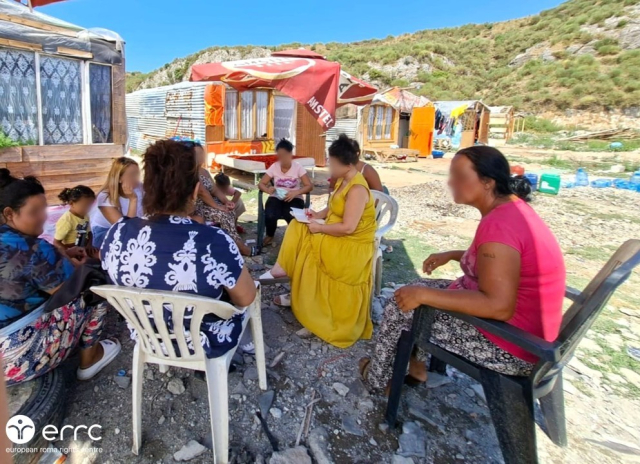
At the entrance to Shkodër, where the municipality is reshaping the riverside to present a cleaner, more touristic image of the city, dozens of Romani families now live among piles of inert waste. Their homes are patched together from tarpaulin, scrap wood, and salvaged metal. There is no running water, no electricity, and no sewage infrastructure. At night, the settlement goes dark with the only light coming from mobile phones and fires.
For the families living there, this is not a temporary emergency. It is the latest chapter in a cycle of eviction and exclusion that has stretched across more than fifteen years. Many of the residents first arrived in Shkodër from nearby towns such as Fushë Krujë, drawn by the possibility of survival work near the Montenegro border. Some collected scrap metal and recyclable materials. Others survived through informal labour or begging. Over time, generations were born and raised in the city yet remained excluded from it. Without formal rental agreements or property ownership, they could not obtain residency registration. Without residency registration, they could not fully access the rights and protections afforded to recognised citizens of the municipality. The result was a community permanently suspended in legal limbo: present, visible, and often economically active, yet officially treated as though it did not belong.
The settlements themselves were always precarious. Families built impermanent shacks on privately owned industrial wasteland littered with debris and refuse. But even these fragile structures have now become difficult to hold onto. Residents have been repeatedly displaced from one informal site to another as the city expanded and redevelopment projects intensified.
In March 2025, the pressure escalated again when around 45 Roma families were evicted from another living area as part of an urban regeneration project linked to riverside improvements at the entrance to the city. Local activists say that no alternative accommodation has been offered. In meetings with local Romani activists, municipal authorities have reportedly justified their refusal to intervene by arguing that the families were not registered residents of Shkodër.
According to Manjola Veizi – a lawyer from the European Roma Rights Centre (ERRC)’s partner Qëndra Për të Drejtat e Gruas Rome (Roma Women’s Rights Centre) – the exclusion that forced these people onto the city’s margins and for years denied them the documentation necessary to become legal residents, is now being used to justify denying them housing assistance.
“If you go to where these people have been forced onto, you will see people living alongside piles of waste, families trying to cook without electricity or clean water, people living with the constant fear that they will be moved again at any moment. These are families who have lived in Shkodër for years, some for generations, yet they are still treated as if they do not belong anywhere. What is happening here is wrong. It is not simply poverty; it is systematic exclusion, perpetrated by the same institutions that failed to recognise these families as citizens in the first place and are now using that exclusion as a reason to deny them their basic human dignity.”
– Manjola Veizi, Human Rights Lawyer
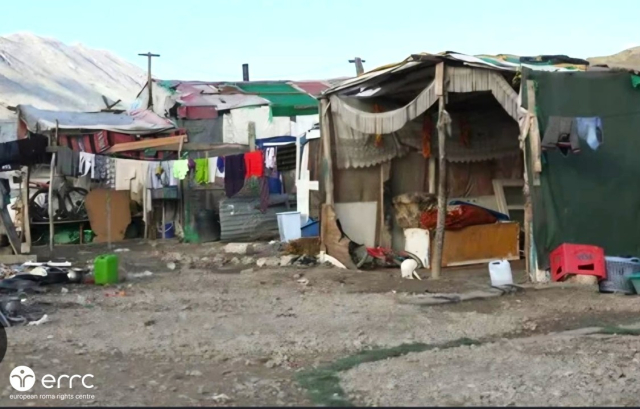
Today, approximately 200 families are believed to be living across five informal living areas in the city. Over the years, these families have been repeatedly evicted and relocated to different informal areas as a result of urban development projects. Of the 45 families evicted in March 2025, 26 were resettled in an informal living area known as “Tepe” where they currently live without access to electricity, safe water, or other essential services. The land is privately owned, adding another layer of insecurity to already desperate conditions. Despite the residents paying a small amount of rent to the landowner, they face constant uncertainty over whether they will be forced to move again. Veizi describes a relationship with landowners that resembles feudal dependency. “They treat them like serfs on their land,” she said.
The humanitarian conditions in the settlement remain precarious, marked by a recent disruption to electricity access. While the families had lived without electricity until August 2025, when a local business owner managed to establish a connection, this relief was short-lived. Just one month later, the electricity distribution company (OSHEE) disconnected the supply without providing a formal explanation. When the Romani families appealed to municipal officials, they were repeatedly told that their "illegal" settlement status precluded access to public services.
In recent weeks, an urgent appeal was sent to OSHEE by the Roma Women’s Rights Centre requesting immediate reconnection, copying several state institutions to highlight the severity of the situation. Despite this, power has not yet been restored. The issue has gained traction at higher levels of government and has been raised internationally; during an OSCE meeting in May, the Roma Vice Minister agreed to personally follow up on the matter. In response to information provided by the Roma Women’s Rights Centre, the Vice Minister expressed concern regarding the situation and committed to taking the matter forward with the relevant authorities to ensure appropriate follow-up and attention to the affected communities.
In the meantime, the legal battle surrounding the settlement is already underway. Albania’s Commissioner for Protection from Discrimination (the national equality body) issued a finding of structural discrimination in relation to the municipality’s treatment of the Romani families on 7th July 2025. The Commissioner requested that the municipality take concrete measures to ensure housing for the evicted families. The municipality was asked to prepare a detailed action plan for the following six months and to submit progress reports every two months. Instead of complying with these recommendations, the municipality appealed the decision and failed to take any meaningful steps toward their implementation. The municipality’s appeal is now before the Albanian Court of Appeal.
Meanwhile, the ERRC and the Roma Women’s Rights Centre are investigating the situation and considering all legal options. Advocates argue that the case raises serious questions under the Albania’s domestic and international obligations, particularly around forced evictions, discriminatory treatment, and the state’s obligations toward vulnerable communities living in extreme racialized poverty.
Several local reports and videos documenting the living conditions and evictions have circulated online, including footage published by Syri TV on the eviction and the lack of electricity and drinking water, as well as by StarPlus TV at the time of the eviction in March 2025.
Beyond the legal arguments lies a more uncomfortable reality about the direction of urban development in parts of southeastern Europe. Across the region, cities eager to attract tourists and investment increasingly market riverfronts, historic centres, and public spaces as symbols of renewal. Romani neighbourhoods that are not regularised and part of the urban plan often become viewed not as communities requiring support, but as obstacles to redevelopment.
In Shkodër, the contrast is stark between one side of the city where promenades and beautification projects signal a modernising future, while on the other, Romani families who have lived in the area for over a decade live on the open ground without electricity, running water, or legal recognition itself. For now, the community still rests at the edge of the city’s redevelopment zone, caught between private landowners, municipal authorities, and a legal system that is now slowly beginning to examine whether what happened there was not simply neglect, but discrimination embedded into the structure of urban policy itself.