
What is the price of a vote? The shocking extent of voter intimidation in Hungary’s poorest communities
02 April 2026
A new investigative documentary A szavazat ára (The Price of a Vote) has sent shock waves across Hungary. Within a couple of days, the film which reveals the extent of voter manipulation by the regime’s fixers, has gotten more than 1.3 million views. The filmmakers found that this system of intimidation now extends beyond the Romani population, and state that 500,000 voters are targeted across 53 constituencies. The objective is to purchase, or otherwise secure, as many of those votes as possible for Fidesz in the April election. The filmmakers’ motivation for making the documentary is to prevent this voter manipulation from succeeding.
With election day less than a fortnight away, and the Orbán regime facing the prospect of defeat in the polls, the ruling party finds itself swamped by a deluge of scandals and controversies, that include allegations of espionage, threats and blackmail by state agents, all manner of Russian interference, and intimidation at election rallies by pro-regime heavies. However, amidst all this drama, it is the revelations in this documentary by the DE! Akcióközösség (De! Action Community) team of investigative journalists, that perhaps rank as the most sinister.
The filmmakers visited 14 of Hungary’s 19 counties, and spoke with dozens of people to expose a sophisticated network established in 53 of 106 constituencies, each of which elects one MP by simple majority, and where Fidesz systematically employs intimidation and vote-buying to secure votes. The film features locations in eastern and north-eastern Hungary, chosen because something seemed amiss concerning the results of the last election, where in some villages Fidesz received 80%-100% of the votes.
Interviews included former participants in vote-buying schemes, opposition voters living in extreme poverty, as well as mayors and police officers who document “the threats and the vulnerability that have become a daily reality for those living in Hungary's small, rural communities.”
Getting out the vote Fidesz-style
One anonymous interviewee described how the network operated to get people out to vote for Fidesz: “The network was activated at midnight. The higher-ups told us what each person had to say, what we had to memorise, what kind of gifts we had to make, how much to give, and for those with addictions what to give them, what to tell them. Word for word, name by name, house by house. We tracked down the people in the villages.”
He described how there were families where ‘some of our guys’ slept over to ensure that they went out to vote the next day, because despite the chickens and the food packages, they didn’t trust the families to go and vote, and they felt they had to deliver, because they themselves were afraid of retaliation. On election day, he described how they transported people in droves, that they would first transport the elderly between 8:00 and 9:00 a.m. After the elderly shift came the youth ‘who don’t like to wake up so early’, and around noon, they went hunting for any missing people.
Inside the polling stations, ‘monitors’ are on hand to see how people have voted. Voters ‘ask for help’ when voting and receive money immediately after leaving the station. Those who don’t ask for help and vote anonymously get nothing, and may even lose their jobs according to one of the interviewees. In other places, people vote ‘openly’ on the table, and not in the booth, so their vote can be observed by a watcher, who makes a call “just one ring, all good, he knows who went in who came out. No need for conversation, just a single ring to say all is good. And they all know which way the votes go, they even count them out there – where they’re at, how many votes they’ve got and how many more they need.”
The anonymous interviewees stated that the system is still up and running, that the going rate for a vote is HUF10,000 (€26), and that in addition to food packages, they now provide drug wraps for those with a habit. However, as the film-makers soon discovered, there was more to the system than mere vote-buying.
“Buying votes is just the icing on the cake”
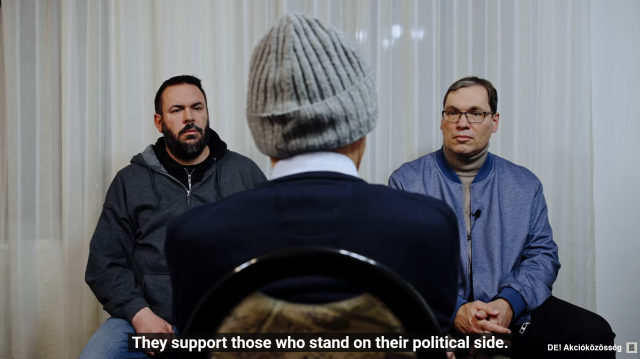
As reported in Telex, filmmaker Áron Tímár said that they had originally wanted to cover the issue of vote-buying, but quickly realised something more disturbing was afoot: “This is about dependency, rooted in vulnerability. Buying votes is just the icing on the cake.” As one anonymous fixer put it,
“This is a constant thing. It’s not that we suddenly scare them the day before the election; it has to be handled so that fear is present in their everyday lives.”
Based on the accounts provided by citizens and police officers in various locations, a similar pattern has emerged in recent years: “those living in extreme poverty are intimidated, and a kind of dependency is created, whereby if they do not vote in accordance with the instructions of the mayor or local authorities, they face retaliation.”
In small settlements where local mayors exercise power over daily lives in a manner more feudal than democratic, the price of dissent comes high. The most startling claims by people interviewed who refused to kowtow were that electricity and firewood subsidies were denied; that they would be deprived of public work (közmunka); that some feared they would not get their medical prescriptions; and that parents were threatened with child protection services making a call and removing their children into state-care. As filmmaker Ádám Tompos put it, “With these threats of removal, the point isn’t whether the procedure actually takes place, but the intimidation, the point is to make one cower, to make them keep their head down.”
When one Romani interviewee, Tibi, made known his intention to run as a local candidate, he was paid a visit to dissuade him from running, two days later his electricity was cut-off – ‘on orders from above’ according to the utility worker – despite having no arrears whatsoever. He was then threatened that things could get even worse ‘and it did get worse’. His son was born but kept in hospital, Child Protective Services took the child and announced that he cannot be released. His wife had to leave the hospital and return home without the baby. Only after the threat of legal action was issued against the services by a local Roma advocate were Tibi and his wife were able to take their new-born child home. Tibi said:
“Because we aren’t bootlickers, because we won’t play along with the Mayor’s little games, this is what happens. Because they’ll ruin me, just as I am. That’s why I don’t dare to run (for office), not because I’m afraid of them, or afraid of anyone but because I have children. They caused us a lot of psychological trauma with this."
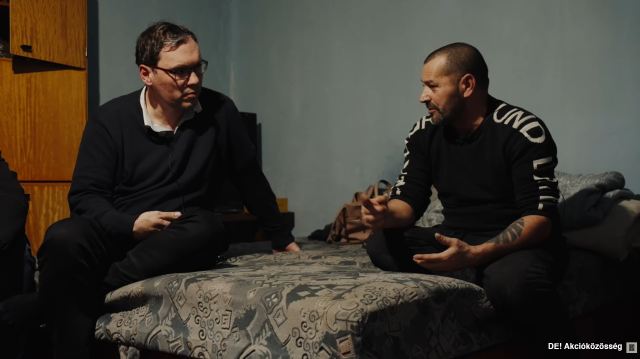
The filmmakers stated that they spoke with hundreds of people – people who had never met each other before, and yet they described the same phenomenon – “as if they were finishing each other’s sentences. This strongly suggested to us that we were not dealing with isolated incidents, but with a systemic pattern.”
The BBC reached out to individual government ministers, and the communications offices of the government, the interior ministry, and the national police for a reaction. The only reply came from Tibor Navracsics, Minister for Public Administration, who declined to comment on any specific allegations made in the film, but made the comment: "If there is any wrongdoing just let the ministry of interior do its job." Considering the scandals past and current that the ministry has been embroiled in, such a suggestion is at best risible.
The stakes on election day
The filmmakers hope that A szavazat ára will serve as a deterrent to mayors who resort to retaliation by showing them that more and more people dare to speak out against these abuses. At the premiere, DE! announced that they will be recruiting volunteers to go to problematic polling stations to monitor the election from the early morning hours, noting that there should be at least 10 observers per polling station, “because otherwise there is a risk that those trying to monitor the integrity of the election could be verbally, or even physically assaulted.”
Much monitoring will be needed as the Helsinki Committee in its latest flash report highlighted that the forthcoming elections are “taking place in a highly polarised political environment, marked by entrenched systemic distortions in electoral competition.” Among the risks to electoral integrity are blurring of boundaries between state and party, opaque and unregulated campaign financing structures, credible allegations of foreign interference, and the increasing prevalence of disinformation and AI-driven manipulation. Another concern is the risk posed by the fact that a key member of the OSCE election monitoring mission to Hungary, Ms Daria Boyarskaya, previously worked for the Russian Ministry of Foreign Affairs and served as an interpreter for Vladimir Putin.
As for potential election-day irregularities, the Hungarian Helsinki Committee echoes the concerns of the filmmakers, citing large-scale vote buying and voter intimidation, which can further exacerbate an already distorted landscape. “Additionally, recent developments suggest that incumbents are resorting to increasingly unrestrained measures to retain power.”
The documentary by DE! Akcióközösség be viewed here.