
Why Community Legal Action Matters
03 August 2026
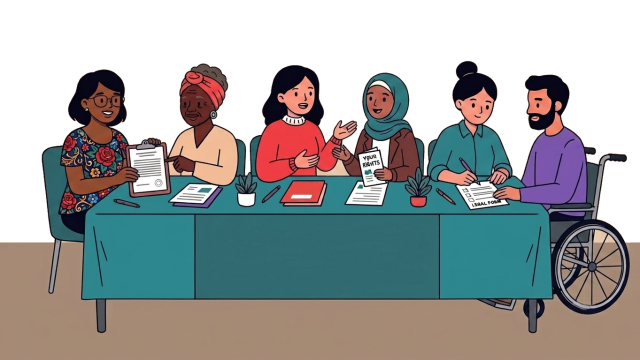
While legal rights exist on paper, actually making use of them is often an entirely different matter.
For many Romani communities across Europe, the gap between having rights and being able to exercise them is wide. People face discrimination in schools, housing, employment, and encounters with police, but may not know what their rights are, how to file a complaint, or where to find a lawyer who will hear their case (and they can afford). Legal protections can remain effectively out of reach for the people who need them most, even when they are written into law.
Community paralegals are people from within marginalised communities who receive training in basic legal skills and human rights law. They are not lawyers. They are neighbours, activists, and parents who learn how to navigate bureaucratic systems, help fellow community members secure identity documents, file complaints, and connect their community with legal professionals when a case requires formal representation. The model has been used from Kenya to India to Sierra Leone, with solid evidence behind it. Evaluations of paralegal programmes have found increases in legal knowledge among participants, more disputes resolved at the community level, fewer rights violations like unlawful arrests and denial of services, and far lower costs compared to formal legal aid. A 2023 study in Health and Human Rights showed that community paralegal programmes can address rights violations affecting access to healthcare and other services. The Open Society Justice Initiative, in its Practitioner's Guide to community-based paralegals, describes the approach as pairing "a small corps of lawyers with a larger frontline of community paralegals" who are "closer to the communities in which they work."
Legal clinics complement this by bringing actual lawyers into direct contact with communities. A clinic might run out of a community centre, an NGO office, or online. People bring their problems: an eviction notice, a child denied school enrolment, a discriminatory refusal of service. Lawyers assess the legal grounds for action, help draft documents, and where appropriate, take on representation. Clinics also serve as a really good way to spot systemic patterns: cases that, if litigated strategically, could challenge the structural discrimination affecting entire communities rather than just individuals.
Training community paralegals in Odessa, Ukraine
The ERRC has been doing this kind of work for over a decade. In 2012, the organisation surveyed Romani communities in the Odessa region of Ukraine and found that 40% of Roma lacked one or more essential personal documents. Without these documents, people are shut out of public life: children cannot enrol in school, adults cannot apply for jobs or access healthcare, and every encounter with police is dangerous.
The next year, the ERRC started a paralegal project in two communities near Odessa, Bolshevik and Korsuntsi. Rather than sending outside lawyers, the organisation recruited paralegals from within the Romani communities. Five people joined: Nona, Dmitri, Valery, Rada, and Nadezhda. They received training and guidance from a lawyer and started taking clients' cases to the authorities.
The results were tangible; in no time at all the paralegals had helped over 50 Roma acquire passports and 30 others obtain birth certificates. Some of them found better jobs, some went back to school, and all were able to walk the streets without fearing ID checks by police.
Nona, one of the paralegals, had originally approached the ERRC asking for help to apply for passports for herself and her parents. ERRC activists suggested she train as a paralegal instead. She agreed, and her parents became her first “clients”. She also later obtained a birth certificate for her son.
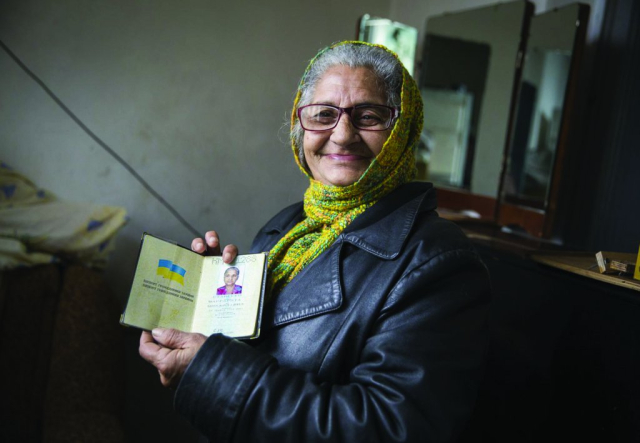
Margarita (above) lost her documents more than 30 years ago when her house was destroyed in a fire. Because she lacked a passport, her children and grandchildren could not get one either. It took two years to research the archives to establish proof of her identity, followed by a 10-month-long court procedure. Margarita received her passport and her grandchildren obtained a birth certificate and could attend school.
What's happening now?
Building on this experience, the ERRC is now involved in an EU funded project working in four countries aimed at setting up community paralegal teams and run legal clinics in marginalised neighbourhoods. In each location, local partners are running the operations:
- Czech Republic: Forum for Human Rights works with disability communities in Prague, while Awen Amenca supports Romani communities in Ostrava.
- Greece: Greek Council of Refugees focuses on migrant and refugee communities in Athens, and Pro Bono Publico is working with Romani communities.
- Hungary: Dzsaj Bhim Community works with Romani communities in Miskolc, supported by the ERRC, while Validity Foundation focuses on people with disabilities in Budapest's 8th district (many of whom are Roma).
- Italy: The Italian Coalition for Civil Liberties and Rights runs clinics serving Roma and migrant communities in Rome.
These local facilitators are working with Romani communities, people with disabilities, and refugees to identify rights violations and connect people with legal support.
The paralegal teams will gather information from residents about discrimination, such as educational segregation, forced evictions, or denial of access to services, and then act as a bridge between communities and lawyers.
The approach is intentionally intersectional. Instead of treating Roma rights, disability rights, and migrant rights as separate boxes, the work tries to identify overlapping forms of discrimination and address them together. In Hungary, for example, activists are coordinating across Romani and disability communities. Community members will lead the paralegal teams, which keeps priorities tied to local needs rather than outside agendas.
How is community legal action different?
Community legal action comes down to a fairly basic idea: people who are left out by bureaucratic systems should have a say in how that system is then used on their behalf by lawyers and activists. They know their own situations better than any outside lawyer or NGO. When communities set the agenda, the work tends to reflect people’s actual material needs rather than the priorities of an outside professional class. Ultimately, the ERRC’s community mass complaints actions in recent years have also shown this to be better at identifying strategic cases that matter to communities more than cases “designed” by lawyers. Legal institutions tend to preserve established hierarchies; controlling the agenda serves as a way to shift power relations.
Aside from strategic litigation, the system of traditional legal aid also has its limits. Lawyers hold the knowledge, clients follow instructions, and success gets measured in court rulings that may or may not change anything in people's daily lives. Community paralegals and community-driven litigation invest knowledge back into communities. They treat legal strategy as one tool among many, something that serves a broader activist effort rather than replacing it with a legal quick fix. The aim is to avoid turning justice into a commodity traded by experts, keeping it instead as something cultivated collectively within the group.
This is crucially important, as structural problems like discrimination in housing, education, or policing rarely get fixed by a single lawsuit. They shift when people are organised, informed, and able to create sustained pressure from multiple directions. Knowing your rights, having a lawyer who takes your case seriously, and being able to spot the cases that could force broader change: that combination is what makes community legal work worth doing.
 |