
Roma Tortured by Serbian Police Win Case at European Court
17 February 2026
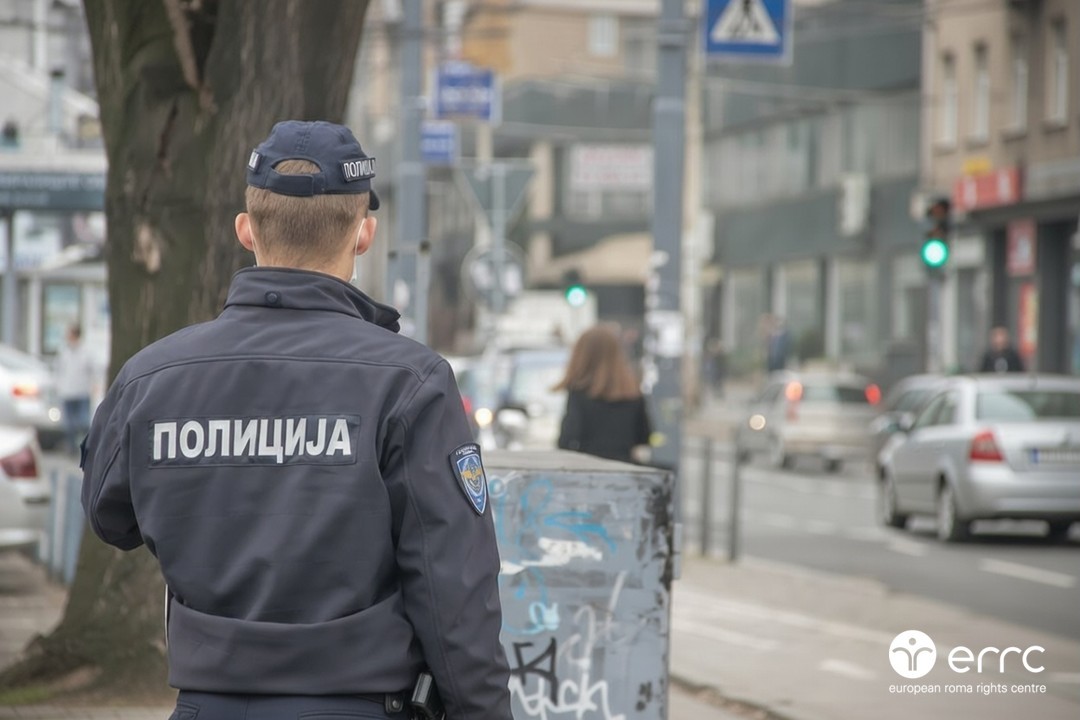
Brussels, 17 February 2026: The European Court of Human Rights (ECtHR) has ruled in favour of a Romani couple who were tortured in a police cell in 2017 after reporting their car stolen. The couple, Marko and Sandra Stalović*, were detained for hours at a police station in Belgrade where officers tortured the husband, racially abused the wife, and threatened to have their children taken by social services. The Court has found that Serbian police discriminated against the Romani couple, subjected Marko to torture and inhuman and degrading treatment, and failed to effectively investigate the crimes committed against the couple after the fact.
“This judgment provides final recognition that what was done to us was unjust and that we ourselves did nothing wrong, no matter what lies were told about us by the police and the authorities” said Marko Stalović to the ERRC. “When we called to report the car stolen, we completely believed that the police would help us and protect us. We naïvely thought, even when we were told to go to the police station in Belgrade, that this meant someone was handling our case, and showed how efficiently and swiftly they were treating the matter. What happened in Belgrade changed all that. Our faith and our trust in institutions, especially the police, is forever gone now. More than the beating and the threats to my life, what I feared most was the threat that they would take our children away – because I didn’t know how much power they had and what they could do. My message relating to this whole ordeal is that in the end justice has won, because the truth has finally come out, and the truth is – we are the innocent ones and we did nothing wrong; nothing to deserve this kind of treatment.”
Andrea Čolak, a human rights lawyer working with the ERRC in Serbia, said “This judgment confirms that Serbia's domestic criminal-law mechanisms, up to and including its Constitutional Court, have utterly failed to deliver justice for Romani victims of police brutality. Nearly nine years on, not a single officer has faced consequences for his actions. What makes this case particularly chilling is that Marko and Sandra actually called the police themselves in the first place to report a crime. They trusted the system, and that trust was weaponized against them. They were lured to Belgrade under false pretences and left with life-long trauma. The European Court has made clear that civil proceedings can never substitute, nor compensate, for a genuine criminal-law response to police brutality and torture. In this case, every procedural safeguard that exists to protect victims was ignored or abused."
Police Brutality and Torture
The incident occurred on 21 April 2017 when the couple, Marko and Sandra, reported their car stolen at Mladenovac police station. They were informed they needed to report the case in Belgrade. Police officers drove them to the ’29th November’ police station in Belgrade in an unmarked car. When they arrived, they were made to undergo a polygraph test before being separated for interrogation.
Marko was made to kneel in a room surrounded by eight officers. The officers slapped his face repeatedly and told him to confess to stealing the car himself and to insurance fraud. They racially abused him and kicked him in the stomach. When he still did not confess, an officer began whipping his outstretched hands with a leather whip. One officer put a plastic bag over his head and squeezed the air out, suffocating him. The same policeman also told him if he did not confess, they would electrocute him. Another cocked his gun, pointed it at him, and told him he would shoot him in the hand to give him "a memory that would stay with him for a lifetime".
When Marko asked to call a lawyer, he was told by an interrogating police officer: “this isn’t Vienna, this isn’t Austria, you don’t make any demands here.” The officers threatened to take his children away to an orphanage and send him and his wife to prison. He heard one of the officers on the phone talking to social services telling them to get a car ready to take his five-year-old and two-year-old girls away.
While Marko was being interrogated, Sandra was in a nearby room with the door open so she could hear some of what was happening. An officer harassed her with comments about her religion and her husband's ethnicity. They continued verbally abusing her while drinking heavily. She was not allowed to use the toilet at all at first, and then only accompanied by a male officer. Her request to see a lawyer was refused.
Finally, at 10pm they were given six documents to sign, which they could not understand the contents of, and allowed to return home. Marko sought medical treatment and was diagnosed with physical injuries to his face and body, as well as post-traumatic stress disorder.
European Court Judgment
The European Court found that Marko had suffered torture and inhuman and degrading treatment at the hands of the police officers (in violation of Article 3 of the European Convention on Human Rights). Additionally, the Court found that the authorities including police and the public prosecutor had failed to effectively investigate the crimes committed against the Romani couple (a procedural violation of Article 3 of the Convention). Furthermore, the Court ruled that these rights violations were as a direct result of discrimination based on the ethnicity of the couple (Article 14 of the Convention), which is uncommon in cases of police brutality due to the burden of proof resting with the victim and the necessity for a high degree of evidence, so much so that it is often virtually impossible to acquire while in police custody.
The Serbian Government has three months to implement the judgment and pay Marko and Sandra non-pecuniary damages amounting to €7500 (€3750 per applicant). The couple were previously awarded non-pecuniary damages on 1st June 2020 by the Belgrade Higher Court in a case also represented by the ERRC: €4,700 euros to Marko for the discrimination, physical pain and fear suffered; and €1,700 to Sandra because of the discrimination and fear suffered.
The Court rejected the applicants’ claim for compensation regarding legal costs and expenses, despite evidence being submitted of lawyers’ contracts and invoices. The costs for legal representation were anyway borne by the ERRC.
The case was represented before domestic courts by human rights lawyer, Aleksandar Olenik.
An interview with Marko Stalović about the abuse he suffered at the hands of the police is available here.
This press release is also available in Serbian.
* In earlier press releases the names of Marko and Sandra were changed to Ivan and Jelena for their safety.
For more information, or to arrange an interview, contact:
Jonathan Lee
Advocacy & Communications Manager
European Roma Rights Centre
jonathan.lee@errc.org
+36 30 500 2118
Andrea Čolak (in Serbian)
ERRC Legal Consultant
European Roma Rights Centre
andrea.colak@errc.org
+381 64 41 39 117 (WhatsApp / Viber / Signal)