
Blurred Lines in Hungary: The 'Day of Honour', Far-Right Paramilitaries and Anti-Roma Racism
26 November 2026
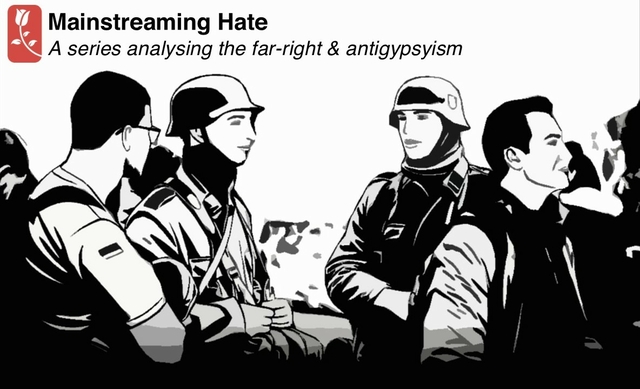
A striking illustration of the blurring of the lines between the radical and extremist strains of the far-right was made clear on the so-called 'Day of Honour' in Budapest on 14th February 2026. This event saw a convergence of interests between the ruling Fidesz party, its loyal opposition the extremist Mi Hazánk, and the paramilitary event organisers. On a cold Sunday, Neo-Nazis from all over Europe converged on the Castle district in Budapest to commemorate the failed breakout attempt by 28,000 Nazi Waffen SS and Wehrmacht units, and their Hungarian allies, as the advancing Soviet army encircled Budapest in early 1945.
For the first time, this event took place without anti-fascist counter protest. The police banned any such gatherings, citing the 2025 Fidesz legislation which declared 'Antifa' to be a terrorist organisation. The lead organiser of the Day of Honour is the 'national resistance movement', Légió Hungária, one in the cluster of far-right paramilitary groups adjacent to the extremist political party Mi Hazánk. Légió Hungária openly venerates historical fascist figures, engages in violent intimidation targeting the Roma, and maintains links to transnational neo-Nazi networks.
For its part, Mi Hazánk, which won seven seats in the 2022 general election on a program which was a mish-mash of conspiracy theories, homophobia, and anti-migrant Islamophobia, is distinctive because of its obsessive anti-Roma racism. In its election posters and leaflets, they pledged to prevent Hungary becoming a "Gypsy country", and stressed "the need to fight against all aspects of Gypsy delinquency" with voluntary self-defence associations.
In Hungary's April 2026 elections, Mi Hazánk's support held firm, it secured 345,252 votes (5.63%), winning six seats. The 2026 election campaign showed that anti-Roma racism was one driving common denominator for the far-right losers. In a shamelessly racist intervention Viktor Orbán openly declaring that while 320,000 Roma have no running water, they will have to hang on and wait, because "first the middle class must be given the opportunity to have their own apartment, because if we start with the lower class, the two classes will turn against each other."
Just days later, his Minister of Construction and Transport, János Lázár, decrying the need for a single migrant in the country, described Roma as Hungary's "internal reserves" to clean the nation's "shit-spattered toilets". As the ruling party began slipping behind in the polls, the same János Lázár publicly called for unity between the "pro-sovereignty" politicians of Mi Hazánk and Fidesz.
The normalising of the 'Day of Honour', coupled with the criminalising of antifascist opposition by the then-ruling Fidesz party, is part of a wider European malaise. The resurgence of anti-democratic forces, the cross-border networking of nationalist and authoritarian political parties, and the exchange of 'best practices' between political and militant extremists, has blurred the lines between nominally constitutional parties, street movements, and criminal paramilitary extremists. This annual 'Day of Honour' in Budapest provides a stark reminder that we are witnessing a persistent and unremitting normalisation of neo-fascism in 21st Century Europe.
But this is not merely about Hungary. The same patterns of violence, hate speech, and collective punishment are manifesting across the continent. Collective punishment by state and non-state actors has been a recurring feature of anti-Roma racism. Roma were frequently singled out for collective punishment throughout the twentieth century, victims of public cruelty orchestrated with official connivance, targeted because of their pariah status and their ethnicity. Mob violence and collective punishment against Roma persist in our present: ideologically-driven and politically orchestrated, such attacks are often carried out with brazen impunity wherever antigypsyism has been mainstreamed as an 'acceptable form of racism'.
The dangers of hate speech and incitement to violence, often masquerading as 'free speech', have become all too apparent, as racists mass on the streets of European cities, and far right parties make their presence felt in local assemblies and national parliaments across the continent. The seeming impunity enjoyed by those who spread hate speech is especially dangerous, because as Bhikhu Parekh warned:
"If anything can be said about a group of persons with impunity, anything can also be done to it. This is because if a group can be treated with contempt, stripped of dignity, dehumanized, treated as belonging to an inferior species, and a moral climate is created in which harm done to it is seen as right and proper and does not arouse a sense of outrage."
Growing far-right mobilization against 'ethnic replacement', multiculturalism and minorities, means that Roma will continue to be singled out for collective blame and collective punishment by cynical nativist politicians and neo-fascist mobsters.
This article is part of the ‘Mainstreaming Hate’ series, adapted exclusively from "The State of Hate: Antigypsyism & the Far-Right in Europe," a section of the Roma Rights Review: Summer 2026, published by the Roma Rights Network and the European Roma Rights Centre (ERRC). It is the fourth of a five-part series drawing on the Review's documentation of anti-Roma racism by state and non-state actors across Europe. The full Roma Rights Review is available here.
The first article was: The Normalisation of Neo-Fascism: Anti-Roma Racism at the Heart of Europe's Far-Right Surge.
Next in the series is: "Mob Violence and Collective Punishment: From Ballymena to the Serbian Village of Tavnik."
 |