
From petals to protest: Romani women carry the torch for International Women’s Day
08 March 2026
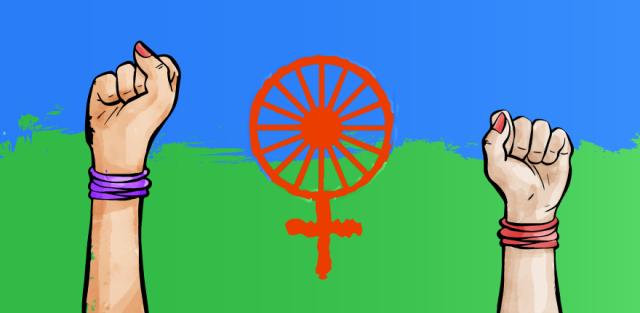
By Judit Ignácz
I remember Women’s Day from primary school. On the 8th of March, I walked home holding snowdrops, tulips, or violets. I received it from the boys in our class who followed instructions from teachers or their parents to honour the girls this way.
In many post-socialist European countries, International Women’s Day still carries this ritual: flowers, polite gratitude, and the celebration of women for their production and reproduction.
But those flowers in my hands did not tell the whole story. A bunch of flowers could not possibly say how women had gone on strike for everyone’s welfare, how women had faced prison for fundamental rights, how women had risked their lives, how women had died.
Women’s Day goes back to the early 20th-century socialist labour and suffrage movements demanding suffrage, fair pay, and safer working conditions. Many of the rights many women hold today - the right to vote, to drive, to own property, to access education, to bodily autonomy - were not granted, they were seized by women who organised, resisted, fought, and continue to fight for them.
International Women’s Day is more than a celebration of the victories we have won; it is also a reminder of that history of resistance and the ongoing fight for equality and justice.
The Origins of March 8th
On February 28, 1909, the Socialist Party of America, with Russian-born labour activist, Theresa Malkiel, mobilised women in New York City to demand women workers' rights and suffrage. In 1910, German socialist Clara Zetkin and women from 17 countries at the Copenhagen International Socialist Women’s Conference agreed to an annual Women’s Day to advocate for women’s rights and equality. March 8 was only chosen after 1917, as on that day, women textile workers in Petrograd (now St. Petersburg) went on strike for “bread and peace”, demanding better pay, humane working conditions, and voting rights. Their strike was a vital spark that helped ignite the Russian Revolution.
The United Nations officially recognised International Women’s Day in 1975, and it is now a national holiday in many countries around the world. In some countries, like Nepal and China, it is a national holiday for women only.
Feminism and Exclusion
What began as demands for fair pay, voting rights, and safer working conditions during the first wave of feminism (1850-1920) evolved into a broader fight for equality. The second wave (1960s–1980s) expanded efforts for workplace equality, reproductive rights, and against domestic violence, while the third wave (1990s–2000s) emphasized diversity, intersectionality, and the voices of racialised women, working-class women, and LGBTQIA+ communities. Today, according to EU data, 1 in 3 women in Europe has experienced gender based violence (including sexual harassment and intimate partner violence), hence the fourth wave of feminism is being shaped by the #MeToo movement and the 16 Days of Activism against Gender Based Violence, confronting any form of violence against women.
Throughout this history, feminism continuously pushed the boundaries of who is seen, who is heard, and whose rights matter. However, mainstream feminism is still marked by exclusion today. It often centres the experiences of white, middle-class, heterosexual, able, urban women, whether in civil society, activism, politics, academia, or the corporate sector.
In 1851, Sojourner Truth called out selectively defined womanhood in her speech “Ain’t I a Woman?” Later, in 1981, Angela Davis explained how sexism, racism, class oppression, and economic exploitation have always been intertwined (in Women, Race and Class). And yet, there still persists in modern-day feminism a blind spot for the needs and experiences of racialised women, as well as women living with disabilities, those of lower socioeconomic status, and LGBTQIA+ women.
True feminism must include anti-racism, social justice, the fight against homophobia, transphobia, islamophobia, xenophobia, and ableism, ensuring that all women’s experiences, needs, and rights are recognised.
Romani Women's Resistance
When mainstream feminism claims women’s progress but ignores the racialisation and feminisation of poverty and intersectional discrimination, it tells only half the truth. And half-truths are a luxury that racialised women cannot afford.
The lived experiences of Romani women are rarely seen and recognized as feminist issues, instead they are framed and treated as isolated, ethnic, and “Roma problems”. Romani women navigate systemic anti-Roma racism, sexism, gender-based violence, and patriarchal practices both in wider society and at times within their own communities.
And the “problems” faced by Romani women and girls are not trivial:
A Romani woman gives birth on a pavement in front of a hospital after being refused medical care. Another is being placed in a segregated maternity ward. A Romani girl is sent to a “special school” because of her ethnicity. Another sits at the back of a segregated classroom, her future already decided for her. A Romani woman packs her family’s belongings when bulldozers arrive at dawn to destroy their house.
A Romani girl dies due to institutional neglect and unsafe living conditions in Italy. A Romani woman dies during a skinhead attack in the Czech Republic. Another dies after a neo-Nazi attack in Hungary. A 9-month pregnant Romani woman dies after waiting 6 hours for Covid-19 test results. Another dies after waiting 2 hours for an ambulance in Sofia.
A Romani woman gets publicly beaten by a minibus driver and fined for disturbing the peace. A Romani graduate is told there are no vacancies, only to watch the next applicant get the job. A Romani woman is grabbed by her throat and pushed by an off-duty police officer.
Another dies after being beaten in Slovakia.
A Romani woman survives domestic violence where support rarely, if ever, reaches. A Romani woman wakes up years later to discover that the surgery, done without explanation and her consent, took away her ability to have children.
And still, Romani women are not passive victims.
We are leaders, workers, organisers, scholars, writers, artists, knowledge producers, advocates, agents of feminist and racial resistance, grandmothers, mothers, daughters, sisters, who have long fought for justice. We have built movements, documented abuses, challenged segregation, and demanded accountability, often without funding, visibility, or protection.
We reclaim the power to define our own experiences and needs, to assert our agency to share our knowledge, to challenge the dominant, colonial, white narratives and state and societal structures that have historically excluded us.
Women March Beyond Borders
Across the world, women are marching for their rights. Women burned their headscarves in Iran and stood against the military coup in Myanmar, fighting against authoritarian regimes. Women resisted police barricades at Taksim Square after Turkey’s withdrawal from the Istanbul Convention. Women in Russia formed the Feminist Anti-War Resistance to oppose the war with Ukraine. International Women’s Day marches take place every year against gender-based violence from India to London, against restricting abortion access in the Czech Republic and Hungary, against femicide in Mexico City, and the annual Women’s March in the USA, all demanding equality, safety, and an end to patriarchal violence.
Romani women stood up when French police executed Romani men in cold blood, raised their voices against the impunity of politicians who use hate speech in Bulgaria, protested the suspicious deaths of Romani and North African inmates in Spain, fought to ensure the first gynaecologist in Shuto Orizari in North Macedonia, and demanded justice for decades to get an apology and compensation after being involuntary sterilised in the Czech Republic.
International Women’s Day is not just a day to thank the women in our lives. It calls us to confront structural oppression, patriarchy intertwined with racism, sexism, poverty, homophobia, ableism, transphobia, islamophobia, xenophobia, state, domestic, and gender-based violence. Reducing March 8th to flowers and polite appreciation betrays its history and the women who risked arrest, exile, violence, and death to expand our freedoms.
When I think of the little girl from primary school, I no longer carry flowers on March 8th. I carry names. I carry stories. I carry the history of resistance of my Romani sisters, and the responsibility to bring it forward.