
Hungarian police warned to cease collusion with neo-fascist vigilantes
14 August 2026
By Bernard Rorke & Judit Ignácz
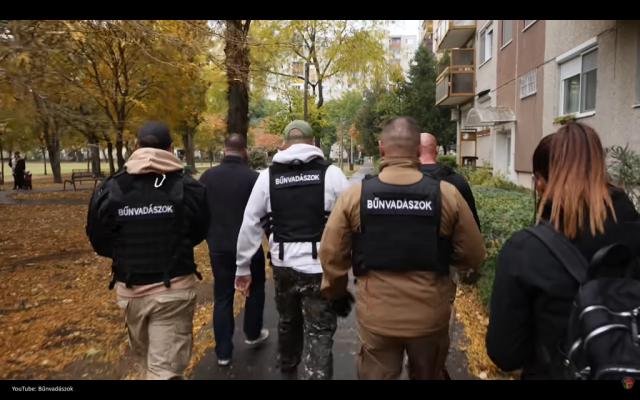
In a welcome move against extreme-right vigilantism targeting Roma, the Hungarian Ombudsman has launched an official investigation over police negligence in connection with activities posted on the Bűnvadászok (Crime Hunters) YouTube channel. The Commissioner specifically warned the National Police Chief that police officers can no longer stand idly by, or actively assist members of the self-styled vigilante group while they carry out potentially unlawful actions, including trespass, intimidation, violent or disorderly conduct.
In what marks a clear break with the recent past, this is a welcome signal from the authorities that there can be no room for anti-Roma racism in a post-Orbán Hungary. Law enforcement have been told that they must immediately investigate and take action to prevent or prosecute criminal offences committed by members of the neo-fascist Bűnvadászok.
As the ERRC reported back in February, the Bűnvadászok were founded and are led by András Bartal, a municipal representative for the extremist Mi Hazánk (Our Homeland) party in Budapest's 15th district. The group operates as part of the larger Magyar Önvédelmi Mozgalom (Hungarian Self-Defence Movement), a network of far-right ‘civil defence’ paramilitary groups.
On their social media channel, the Crime Hunters describe themselves as "a team of patriots fed up with the state being unable to protect the property and personal safety of decent Hungarians." They produce and distribute videos purporting to show how to "neutralise criminals" and "those who consciously violate laws." Their stated objective is to “create order and perfect public safety in the entire society."
In their ‘mission’ to deal with the unauthorized occupation of properties, the vigilante gang drive about in a converted Ford Transit Van (paid for by Mi Hazánk), breaking into homes, intimidating residents, and using physical force to impose their own brand of justice. The racist motivation seems to be a matter of pride, as András Bartal has openly admitted to disproportionately targeting Roma (who are frequently referred to as “parasites” on their social media channels.
According to a complaint filed with prosecutors in March 2026, and the cache of incriminating videos online, the Crime Hunters' modus operandi is as follows: the group appears at various locations across Hungary targeting alleged unauthorised squatting of apartments or houses. They break into the affected properties, demand personal data from those present, and then order them to leave using verbal threats and, when that doesn’t work, physical intimidation to enforce compliance. Often, they vandalise the home by dismantling doors and windows with tools so that the place is uninhabitable.
16 years of blurred lines between the Orbán regime and its friendly fascists
The brazenness, and for a time, seeming impunity of Mi Hazánk’s Crime Hunters was a product of a sinister blurring of lines between the forces of the governing far right and extremist factions in Hungary between 2010 and 2026. The lax and laissez-faire attitude of the former Orbán regime to an overtly Nazi event – this February’s annual ‘Day of Honour’ – which glorifies the SS and their Arrow Cross allies as heroes, while banning ‘Antifa’ as a terrorist organization was particularly telling. The lead organiser of the Day of Honour is the ‘national resistance movement’, Légió Hungária, one in the cluster of far-right paramilitary groups adjacent to the extremists of Mi Hazánk. Légió Hungária openly venerates historical fascist figures, engages in violent intimidation targeting the Roma, and maintains links to transnational neo-Nazi networks.
Since it was founded in 2018, and until the 2026 election, Mi Hazánk functioned as a friendly opposition party to the Fidesz regime in what Political Capital described as a ‘symbiotic relationship’, where the regime took its topics and messages from the extremists, and in turn presented itself as the driving force and very embodiment of the will of the nation.
Mi Hazánk, which received 359,000 votes (5.6%) and six parliamentary seats in the 2026 general election, routinely campaigns on a mish-mash of conspiracy theories, neurotic homophobia, and anti-migrant Islamophobia, remains distinctive on account of its virulent and obsessive anti-Roma racism. In their national version of ‘great replacement’ theory, Mi Hazánk frequently declared that while the birth rate of Hungarians plummets, “Gypsies are producing a population explosion typical of the Third World. The number of Gypsies doubles by generations, while the number of Hungarians is almost halved.” A favourite campaigning slogan is the call to halt "the Gypsification (sic!) of Hungary"’ all the while stressing “the need to fight against all aspects of Gypsy delinquency” with voluntary self-defence associations.
The Bűnvadászok, in their uniform of brown shirts and matching cargo-pants are just the latest iteration of such neo-fascist ‘voluntary self-defence associations’. Just two years after a neo-Nazi wave of terror claimed six Romani lives, and wounded dozens of others, extremist paramilitary groups staged an unprecedented display of racist vigilante force in the village of Gyöngyöspata in 2011.
Uniformed far-right paramilitary groups, including successors to the banned Magyar Gárda, descended on the village and established ‘civil guard patrols’ in response to alleged Romani crime. Backed up by skinheads bearing whips and attack dogs, these groups conducted intimidating patrols through Roma-majority streets, set up checkpoints, and created an atmosphere of terror for two and a half weeks. The paramilitaries claimed they were simply "keeping order" and "protecting" Hungarian residents.
Throughout the occupation of Gyöngyöspata, Hungarian police idly stood by. Despite clear evidence of organised intimidation, the authorities singularly failed in their obligation to protect Romani residents. Then prime minister Orbán praised the police for their restraint and their presence as a deterrent, claiming without a shred of irony that otherwise “ugly things could have happened”.
In the intervening years there were many other displays of racist vigilante force, where the pretext was to combat "Gypsy crime", and the intent was to terrorise Romani communities, and the police just stood aside. On 5 August 2012, an estimated 1000-strong mob of neo-Nazis and far-right thugs descended upon the western town of Devecser. Video footage showed Zsolt Tyirityán of Betyársereg (Outlaw Army), speaking of racial warfare and ethnic cleansing. “The gypsy is coded in such a way that criminality is in him,” he said. “I consider myself a racist, and I am going to stand up for the cause of not giving our living-space over to an ulterior race.” Other statements included: “The genetically coded trash must be exterminated from public life”; “We are going to stamp out this phenomenon, it must be extirpated from our lives.” The demonstrators marched on the Romani neighbourhood chanting “Gypsy criminality”, “Gypsies, you will die”, and “We will burn your house down and you will die inside”.
Calling time on racists and racist policing
What made this case different was that in 2017, the European Court of Human Rights delivered a judgement that found fault with law enforcement and the state authorities. The court found that the cumulative effect of shortcomings in the investigations, especially the lack of a comprehensive law enforcement approach into the events, was that an openly racist demonstration, with sporadic acts of violence remained virtually without legal consequences and the applicants were not provided with the required protection of their right to psychological integrity.
The court found that the applicants were left without effective legal protection against an openly anti-Roma demonstration, the aim of which was no less than the organised intimidation of the Roma community, including the applicants, by means of a paramilitary parade, verbal threats and speeches advocating a policy of racial segregation. And in a particularly damning final sentence: “The Court is concerned that the general public might have perceived such practice as legitimisation and/or tolerance of such events by the State.”
In his inauguration-day address to the nation, the new Prime Minister Péter Magyar declared an end to the era of Orbán's "hatred, fear and constant incitement", which he said had poisoned the soul of the entire nation, and promised a just and humane home for all its citizens. Firm and prompt action will be needed to prevent any future displays of racist intimidation of Romani communities by neo-fascist mobsters.
Directly related to the issue of extremist public displays of force is the manner in which Hungary’s Roma have been over-policed and under-protected. The government must tackle these long-standing failures in policing on the ground if there is to be any prospect of establishing trust between the Romani communities and law enforcement agencies who are constitutionally bound to serve and protect all citizens regardless of their ethnicity. Central to this is the issue of police brutality.
In its January 2026 submission to the Committee of Ministers, the Hungarian Helsinki Committee (HHC) accused the Hungarian authorities of failure to take the necessary measures to prevent police ill-treatment and “introduce any meaningful legislative or policy reforms to address the systemic problems surrounding police ill-treatment to ensure effective accountability.” As a result, the HHC concluded that “the structural deficiencies identified by the European Court of Human Rights more than a decade ago continue to undermine accountability and deny victims effective access to justice.” The overwhelming parliamentary majority secured by Tisza at the polls, and the declared will of this government to restore the rule of law, provides a historic opportunity to finally combat anti-Roma racism in policing.