
Roma Targeted Again: Hungary's Latest Far-Right Vigilante Group Echoes Dark History
25 February 2026
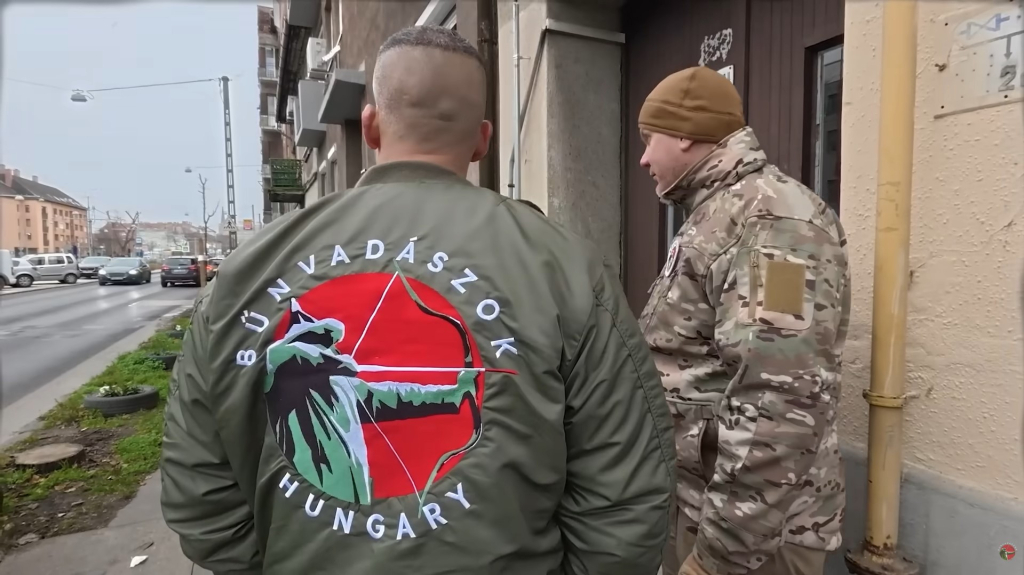
Hungarian prosecutors have last week initiated criminal proceedings against the "Bűnvadászok" (Crime Hunters), a vigilante group linked to the far-right Mi Hazánk party, whose strong-arm tactics have been compared to "the SA terror of the Nazi dictatorship." The charges, brought after a complaint was filed in March 2025 by Romani complainant József Ferenczik, will likely include group vigilantism and violation of personal freedom. The Crime Hunters represent the latest chapter in Hungary's decades-long struggle with far-right violence against Romani communities, where patterns of intimidation, police complicity, and systemic impunity continue to repeat themselves.
The complaint alleges that the Crime Hunters' operations show "an eerie parallel with the SA terror seen at the dawn of the Nazi dictatorship: civilians provoke a crime, then 'pass judgment' with physical violence and intimidation, while the police legitimise the vigilantism through passive assistance."
The language used to describe the group’s actions in the complaint may seem histrionic, but more astonishing still is the group leader’s open admission to disproportionately targeting Roma (who are frequently referred to as “parasites” on their social media channels). Despite this, the Crime Hunters continue to operate with apparent impunity, backed by elected officials from Hungary's far-right Mi Hazánk party.
Who Are the Crime Hunters?
The Bűnvadászok were founded and are led by András Bartal, a municipal representative for the far-right Mi Hazánk (Our Homeland) party in Budapest's 15th district. The group operates as part of the larger Magyar Önvédelmi Mozgalom (Hungarian Self-Defence Movement), a network of far-right "civil defence" paramilitary groups.
Mi Hazánk itself was formed in 2018 by former members of the Jobbik party who believed that party had become too moderate after its attempt to rebrand toward the political centre. The party is led by “virulent, anti-Roma racist”, László Toroczkai, and has gained representation in several local governments as well as the European Parliament, using a political platform largely based on radical anti-Roma rhetoric.
On their social media channels, the Crime Hunters describe themselves as "a team of patriots fed up with the state being unable to protect the property and personal safety of decent Hungarians." They produce and distribute videos purporting to show how to "neutralise criminals" and "those who consciously violate laws"; videos that, as their own leader has acknowledged, predominantly show Romani people as targets.
The group's stated mission is to address the unauthorised occupation of properties, imagining themselves as extra-judicial enforcers, filling a gap left by ineffective law enforcement. In reality, their methods constitute textbook, racist vigilantism. They go about in a converted Ford Transit Van (paid for by Mi Hazánk), breaking into homes, intimidating residents, and using physical force to impose their own brand of justice (all filmed a bit like a cringey, fascist take on the day-time-television reality show Storage Hunters).

Methods of Intimidation
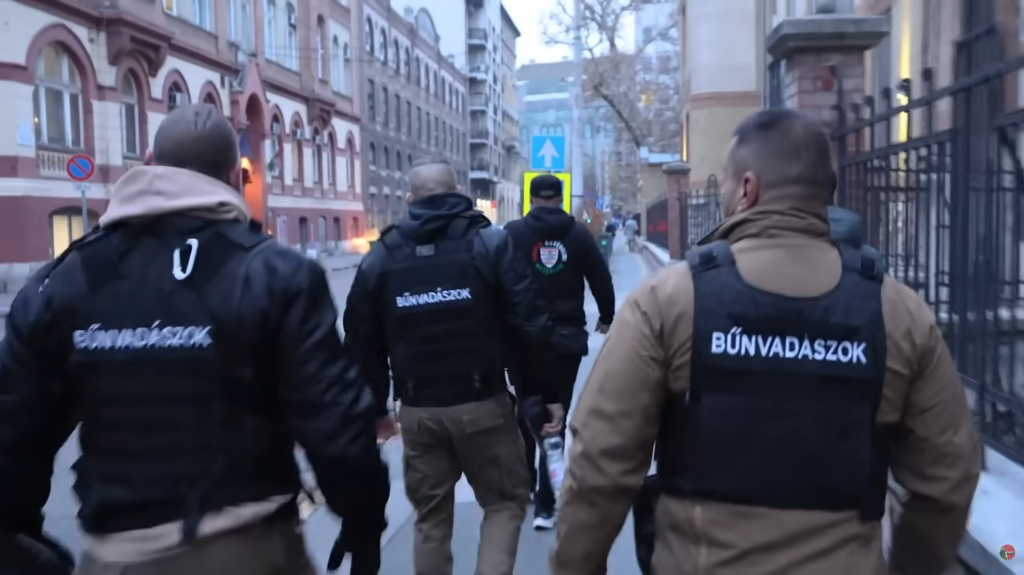
According to the complaint filed with prosecutors, and the cache of incriminating videos online, the Crime Hunters' modus operandi is as follows: the group appears at various locations across Hungary targeting alleged unauthorised squatting of apartments or houses. They break into the affected properties, demand personal data from those present, and then order them to leave using verbal threats and, when that doesn’t work, physical intimidation to enforce compliance. Often, they vandalise the home by dismantling doors and windows with tools so that the place is uninhabitable.
The victims of these actions are typically Romani families living in precarious housing situations; people who are already vulnerable due to systemic discrimination in the housing market, chronic racialised poverty, and social marginalisation. The Crime Hunters exploit legal ambiguities around property disputes and housing occupancy to justify their racial intimidation under the guise of vigilante law enforcement.
Aside from some of the Crime Hunters literally wearing brown tops and brown cargo-pants (see below), the complaint's comparison to Nazi-era Sturmabteilung (SA) tactics is not complete hyperbole. Like the brownshirts of 1930s Germany, the Crime Hunters operate in a grey zone between unofficial violence and state authority, with their actions tolerated (or even quietly encouraged) by elements within law enforcement. The pattern described in the complaint is chillingly familiar to embryonic fascist actions throughout history: civilians provoke confrontations, administer "justice" through intimidation and force, and the police legitimise the vigilantism through passive acceptance or active collaboration.
"Based on the Videos, They Mainly Go Out to Roma People"
In a June 2025 interview with the Hungarian news outlet Telex, András Bartal was directly confronted about the overwhelming pattern in his group's videos of showing Roma being targeted and portrayed as squatters. His response was remarkably candid: "Based on the videos, they mainly go out to Roma people, showing them as squatters" ("A videók alapján főleg romákhoz vonulnak ki, őket mutogatják lakásfoglalókként.")
Bartal doubled down on this, attempting to justify it with an analogy that revealed more than it concealed: "If I am to visit a prison, I can’t help what percentages of people of different skin colours are there" ("Ha én bemegyek egy fogházba, akkor nem tehetek arról, hogy itt milyen százalékban milyen bőrűek Vannak.")
The prison comparison is telling. It reflects a worldview in which Romani people are inherently associated with criminality, where their disproportionate targeting is explained away as merely reflecting an underlying reality rather than being recognised as discriminatory targeting itself. This circular logic – Roma are targeted because they commit crimes; the evidence that they commit crimes is that they are targeted – is as old as racism itself and has been used to justify antigypsyism for generations.
Bartal continued: "If someone in distress calls me, and there happen to be Gypsies there, then there are Gypsies there. I've never had a phone conversation where I said, if they're Gypsies, then we'll go out, if they're Hungarians, then we won't."
This denial of explicit racial selection ignores the obvious: if the group's videos "mainly" show Romani people as targets, if their leader admits this pattern, and if the group operates in a political environment saturated in anti-Roma rhetoric (more on this below), then the targeting is discriminatory regardless of whether Bartal explicitly says let's go get the Gypsies or not. Discrimination is about the disparate impact, not just the explicitly stated intent.
"Subhuman" and "Parasites": The Openly Fascist Ecosystem Supporting the Crime Hunters
The Crime Hunters do not operate in a vacuum. They are the brutish, street-level enforcement arm of a broader political movement built on anti-Roma hatred that is clustered around the far-right part Mi Hazánk. To understand the significance of Bartal's vigilante group, we have to look at the overtly racist political environment in which they operate.
On September 13, 2025, Mi Hazánk organized a demonstration in Szolnok, a city northeast of Budapest, ostensibly to address ‘crime and public safety’. The event can be viewed as a primer on the kind of fascist ideology that animates groups like the Crime Hunters in Hungary.
In this event, various fascist talking heads gave length convoluted speeches full of contradiction and conspiracy theory. One such intervention was from Tyirityán Zsolt, the leader of the Betyársereg (“Outlaws Army”, another Mi Hazánk-affiliated paramilitary group), who delivered a speech in which he stated, "Roma rights advocacy is a form of subhuman existence" ("a cigány jogvédelem az ember alatti lét egy formája".)
Who needs a dog whistle when you’ve got a megaphone eh?
There’s no mincing of words in these circles; no need for coded language when you can openly engage in explicit dehumanisation using Nazi racial terminology.
Tyirityán continued: "Amongst a significant part of the Gypsies, Hungarian-hatred is fashionable, which Roma legal advocates refuse to acknowledge."
The rhetorical formula is familiar from fascist movements throughout history: a marginalised minority is accused of hating the majority population, their advocates are delegitimised and dehumanised, and violence against them is framed as defensive rather than aggressive. At the same demonstration Pakusza Zoltán, the chairman of Mi Hazánk's "Gypsy affairs cabinet" (yes, they have a "Gypsy affairs cabinet") spoke about "families keeping people in terror" and crimes in Szolnok, while Bartal András himself spoke about "deterring parasites."

This is the political movement that backs the Crime Hunters. This is the ideology that animates their street actions and motivates their foot soldiers. When Bartal's group breaks into Romani homes and forces families out through intimidation and threats, they are not merely addressing property disputes, they are enacting a political program of ethnic intimidation with the blessing of elected officials who organise events in which Roma rights advocates are described as "subhuman" and Romani communities as “parasites.”
A History That Repeats: Anti-Roma Vigilantism in Hungary
For those familiar with Hungary's recent history, the Crime Hunters are only the newest iteration of a much larger problem. This is not the first time that far-right paramilitary groups have terrorised Romani communities under the guise of maintaining public order. It is not even the first time this decade:
The Magyar Gárda (2007-2009)
In 2007, the far-right Jobbik party founded the Magyar Gárda (Hungarian Guard), a uniformed paramilitary organisation that conducted marches of intimidation through Roma-majority villages and neighbourhoods. The Gárda wore uniforms deliberately designed to evoke the aesthetic of the Arrow Cross, Hungary's fascist party during World War II which was responsible for the murder of tens of thousands of Jews and Roma during the Holocaust.
Gárda members would habitually arrive in Romani communities, conduct marches in military formation, and create an atmosphere of menace and fear. They claimed to be addressing "Gypsy crime" and protecting "Hungarian" residents. In reality, they were conducting organised racial intimidation.
In 2009, Hungary's Constitutional Court banned the organisation, declaring it unconstitutional. But the ban was largely symbolic. Many Gárda members faced no individual consequences and some even went on to political careers, including within what would become the Mi Hazánk party. In 2013, The Magyar Gárda was dissolved after the European Court of Human Rights upheld the Constitutional Court’s ban and ruled that its leader, Vona Gábor, had not had his right to free speech violated. The ERRC submitted a third-party intervention which addressed evidenced discrimination against Roma. The organisation reformed under different names, continuing its activities in new forms.
The way Hungarian courts dealt with the Magyar Gárda is instructive for the current prosecution of the Crime Hunters. It demonstrated that Hungary would ban the most overtly fascist symbolism, but the underlying phenomenon of far-right groups using "public safety" rhetoric to justify anti-Roma violence would be tolerated, and those who participated would face minimal individual consequences.
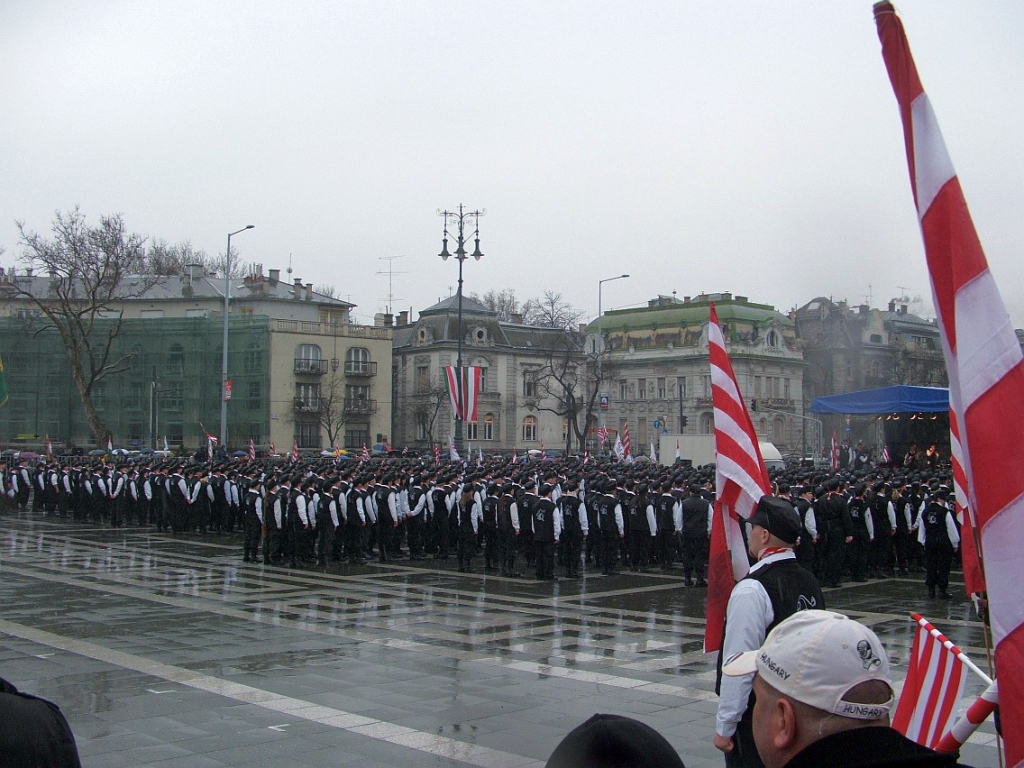
The swearing in of new Magyar Gárda members at Heroes Square, Budapest on 15th March 2009/ Photograph: Várkonyi Tibor (Creative Commons)
The 2008-2009 Wave of Far-Right Terror
The climate of hatred fostered by groups like the Magyar Gárda had real-world consequences. Between 2008 and 2009, a series of attacks on Romani homes killed six people, including a five-year-old child, Robika Csorba, and his father. The perpetrators used Molotov cocktails and firearms, targeting Romani families as they slept.
When eventually caught and tried, the perpetrators claimed they were motivated by "Gypsy crime", the same rhetoric used by the Magyar Gárda and now by the Crime Hunters. They saw themselves as soldiers in a race war, protecting Hungarians from a Romani racial threat.
The far-right terror attacks demonstrated that vigilante rhetoric and paramilitary intimidation do not remain abstract. They create an environment in which violence against Roma is normalised, even celebrated. The Crime Hunters operate in the wake of these murders, in a country where anti-Roma vigilantism has living memory of progressing from intimidation to assassination (with little to no societal reconciliation in the aftermath).
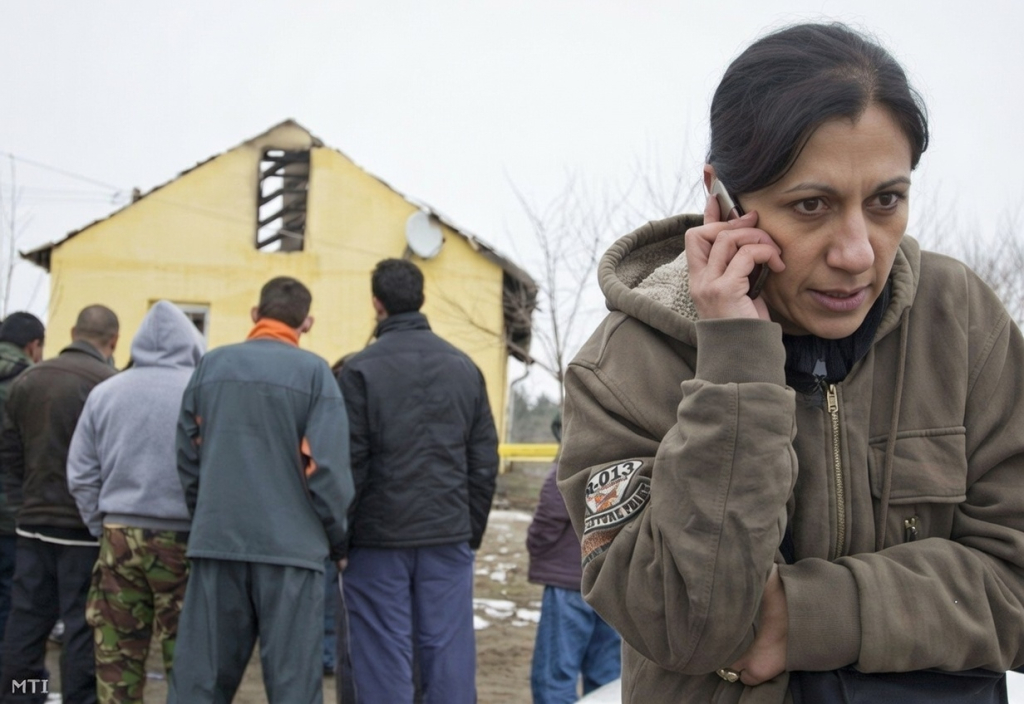
Romani activist, Victória Mohácsi, at the scene of the double murder in 2009. Her work documenting neo-Nazi hate crimes against Roma led to constant death threats against Viktória and her young family. Photograph: Magyar Távirati Iroda.
Gyöngyöspata (2011)
In March 2011, the village of Gyöngyöspata became the site of one of the most extensively documented cases of anti-Roma vigilantism in modern Hungary. Uniformed far-right paramilitary groups, including successors to the banned Magyar Gárda, descended on the village and established "civil guard patrols" in response to alleged Romani crime.
Backed up by skinheads bearing whips and attack dogs, these groups conducted intimidating patrols through Roma-majority streets, set up checkpoints, and created an atmosphere of terror for two and a half weeks. Romani children were afraid to go to school and families were trapped in their homes for fear of being caught on the streets by the fascist patrols. trapped in their homes. The paramilitaries claimed they were simply "keeping order" and "protecting" Hungarian residents.
Throughout the occupation of Gyöngyöspata, Hungarian police idly stood by. Despite clear evidence of organised intimidation, authorities took minimal action to protect Romani residents. Prime Minister Viktor Orbán praised the police for their restraint and their presence as a deterrent, claiming “ugly things could have happened” otherwise.
One person got some measure of justice before the European Court of Human Rights. In 2016, the Court ruled that local authorities had failed to adequately investigate an incident where a man taking party in one of the paramilitary patrols swung an axe at a Romani person and told them, “Go inside, you damned dirty Gypsies!” and that he would build a house in their neighbourhood “out of their blood.” However, no perpetrators ever faced criminal prosecution. The Hungarian state was ordered to pay €4000 compensation to the one victim, but the vigilantes themselves faced no consequences. The message sent was clear: groups can terrorise Romani communities with impunity, as long as they claim to be concerned about crime.
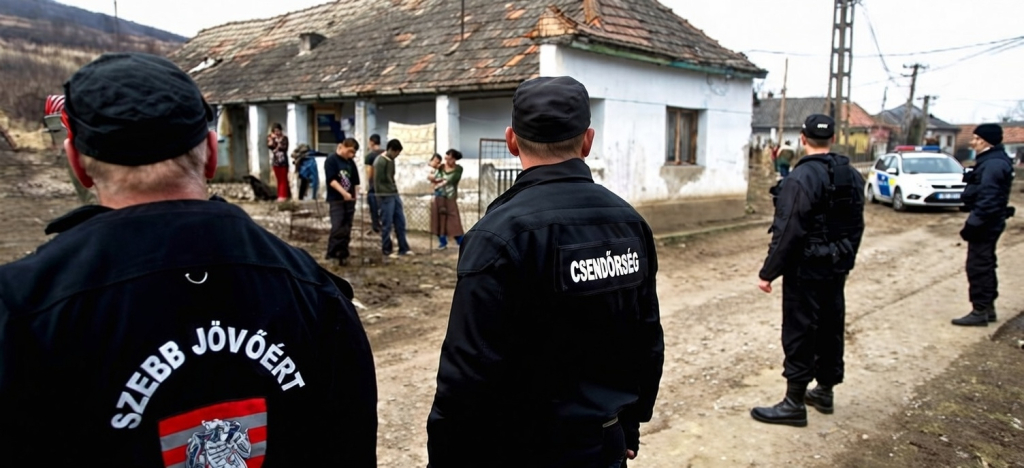
Members of the Civil Guard (Szebb Jövőért) paramilitary group surround the house of a Romani family in Gyöngyöspata, 12th March 2011. Photograph: Hungarianambiance.
The Far-Right Vigilante Model
All these groups seem to be reading from the same play book; each one repeating the same pattern of violence and impunity with every successive organisation building on the actions of the last.
The pattern is as follows:
- A far-right group forms under the guise of "protecting public safety".
- The group carries out organised intimidation of Romani communities – whether through marches, patrols, or home invasions – in order to create fear and assert dominance.
- The police fail to protect Roma by standing aside and turning a blind eye, or are actively complicit in the actions and collaborate by treating Romani victims as criminals rather than the vigilante perpetrators.
- The Courts fail to hold individual perpetrators accountable (even if organisations are banned).
- When faced with dissolution, the far-right groups disband, rebrand, and reform under new names and different configurations.
- The cycle repeats. Each iteration of vigilante activity builds on the last, with tactics and rhetoric becoming more brazen as impunity is demonstrated.
The Crime Hunters are the latest iteration of this cycle. They have learned from their predecessor groups (and indeed contemporaries) that operating under the cover of "property disputes" and “against criminality”, as well as having political backing and tacit law enforcement approval, will likely protect them from meaningful consequences. History suggests they are right.
The ERRC’s Legal Analysis: Will Justice Be Served?
The charges filed against the Crime Hunters are serious and, on paper, carry significant potential penalties. Nonetheless, the realistic prospect of conviction remains unlikely according to Hungarian human rights expert, Vivien Brassói.
The Charges
Hungarian prosecutors could initiate proceedings on two charges:
Group vigilantism (csoportosan elkövetett önbíráskodás) – Article 368 of the Hungarian Criminal Code defines vigilantism as ‘private justice’ or taking the law into one's own hands, enforcing perceived rights through force or threat of force. When committed by a group the offence is considered aggravated and penalties increase significantly. The maximum sentence is five years imprisonment; extending to eight years if weapons are involved.
Violation of personal freedom (személyi szabadság megsértése) – Article 194 of the Criminal Code covers unlawful deprivation of liberty, coercion, and intimidation. It prohibits forcing someone to do or refrain from doing something against their will through violence, threat, or intimidation. The maximum sentence is three years imprisonment, with up to five years in aggravated cases.
Both charges fit the described conduct precisely. The Crime Hunters routinely break into occupied properties (using force), demand that residents leave (through coercion), and use physical intimidation and threats to enforce compliance (violating personal freedom). They also do this as an organised group (the aggravating factor) and have documented their actions extensively online (providing evidence).
Evidentiary Strength
From a purely evidentiary standpoint, this should be a straightforward prosecution. The Crime Hunters have created an extensive video record of their own activities. These videos show forced entry into multiple occupied properties, confrontations with residents, demands that people leave immediately accompanied by threats of violent consequences if they do not comply. Many videos demonstrate physical intimidation and, in some cases, physical contact with the people being targeted, as well as alterations to the property (such as dismantling doors and windows) in order to force people out.
Beyond the video evidence, there are multiple victims who can testify to being threatened and coerced, as well as András Bartal's own admission in the interview with Telex that the group "mainly goes out to Roma people”, potentially establishing discriminatory intent.
Any competent prosecutor should be able to secure convictions on these facts. The defendants have documented their own crimes, admitted them publicly, and continued to commit them openly. This is not a close case on the evidence.
The Weight of History and Why Conviction Is Unlikely
Hungarian human rights lawyer, Vivien Brassói, said in an interview with the ERRC that “anyone familiar with Hungary's record on prosecuting anti-Roma vigilantes would be foolish to expect meaningful accountability.” The aforementioned history of ineffective legal action against the Magyar Gárda, the occupiers of Gyöngyöspata, or the wider ecosystem of anti-Roma hate groups in the wake of the 2008-2009 killings provides a more sobering reality check as to the likely outcome of the Crime Hunters case. Hungarian law enforcement and courts treat anti-Roma vigilantism with a permissiveness that itself borders on complicity.
Political Protection
On top of the weight of history, there is the fact that András Bartal is not just a vigilante; he is an elected municipal representative with political backing from a party that has representation in local governments across Hungary. Mi Hazánk may be a relatively small party nationally, but it has carved out a significant presence in local politics, particularly in areas where anti-Roma sentiment runs high (along with accusations of the tacit, behind-the-scenes blessing of Fidesz who treat Mi Hazank as a ‘satellite party.’)
Bartal's political position insulates him with several layers of protection. His public platform means he can portray any prosecution as political persecution, claiming he's being targeted for "defending Hungarians." The strength of his party and street movements means that Mi Hazánk can mobilize supporters and put political pressure on prosecutors and judges, while a national media sympathetic to the plight of beleaguered fascists can portray him as a martyr standing up to a system that protects “Gypsy criminals.” Prosecutors and judges may also wonder at the political cost of punitive action against Bartal in a country where anti-Roma sentiment is so normalised.

Mi Hazánk party leader László Toroczkai (left) and Bűnvadászok (Crime Hunters) leader András Bartal (right)
Photograph: Toroczkai.info
Hungary's current political environment makes prosecution of far-right activists challenging. Whilst the ruling Fidesz party and Mi Hazánk are technically rivals, in that they compete for the same voter base, Fidesz has little incentive to crack down on anti-Roma vigilantism. It has little political benefit to them so close to the national elections, while taking action might make Fidesz look "soft on Gypsy crime" to its own base.
Likely Outcomes
Based on the ERRC’s monitoring of historical patterns in Hungary, and familiarity with Hungarian jurisprudence on anti-Roma vigilantism cases, one of the following outcomes is likely:
Scenario 1: A lengthy investigation leading to dropped charges or acquittal (Most likely)
In this scenario, the prosecution moves slowly, public attention fades, and eventually charges are quietly dropped due to "insufficient evidence" or a court acquits on the grounds that the defendants were trying to help property owners exercise lawful rights. The Crime Hunters claim vindication and continue their activities.
Scenario 2: Conviction with a suspended sentence (Moderately likely)
To appear responsive to the complaint and international criticism of the breakdown of rule of law, the courts convict but on reduced charges and impose only suspended sentences. In this scenario, the defendants face no actual prison time, pay only minimal fines, and mostly likely continue with their activities. This allows the system to claim accountability while ensuring no meaningful consequences for those involved.
Scenario 3: Conviction, but the group reforms under new name (Possible)
We’ve seen this one before. Here, the courts convict and impose some restrictions on the defendants, but the group simply rebrands and continues under a different name with new leaders, following the Magyar Gárda playbook. The cycle continues.
Scenario 4: Actual imprisonment to set an example as a deterrent (Very unlikely)
The outcome that should happen if politics are removed from the equation. The courts take the charges seriously, impose actual prison sentences, and send a message that vigilantism and racial intimidation will not be tolerated in Hungary.
The International Factor
One element that could alter these calculations is international pressure. The European Commission is currently monitoring Hungary for rule of law violations on multiple fronts. The country faces ongoing Article 7 proceedings and has had EU funds withheld due to governance concerns.
If the Crime Hunters case gains significant international attention – for example, if human rights organizations highlight it as emblematic of Hungary's failure to protect Roma from vigilante violence – it could add some pressure on Hungarian authorities to take the prosecution seriously. The Gyöngyöspata case showed that international court intervention can eventually force some small measure of accountability, even if individual criminal prosecutions remain elusive. The Crime Hunters case could become a test of whether Hungary has learned from that experience or whether the pattern of impunity will continue. But international pressure is no guarantee of justice. Hungary's current government has shown its eagerness to ignore international criticism where it serves domestic political wants. If prosecuting the Crime Hunters is seen as politically costly, all the international condemnation in the world is likely not enough to influence action.
What would justice look like?
For this case to represent a genuine break from Hungary's pattern of impunity for anti-Roma vigilantism, several things would need to happen:
- A swift and decisive prosecution consistent with the strength of evidence arrayed. Not years of delays that allow public attention to fade
- Serious charges maintained throughout the trial; that is, no reduction to minor offenses to make conviction easier to swallow.
- Actual imprisonment when it comes to sentencing. Not suspended sentences or fines, but hard-time consequences that sends a deterring message to any would-be future vigilantes and fascist knuckle-draggers.
- A top-down, independent investigation of police complicity in far-right crimes against Roma to hold officers who provided "passive assistance" individually accountable for their actions.
- A political agenda that focusses on learning from the outcomes of this case to make systemic reforms, recognising that the Crime Hunters are a symptom of a broader problem requiring policy changes in Hungary.
We can always dream right?
The Daily Reality, Living Under Threat
Lost in the legal analysis and political context are the actual human beings targeted by the Crime Hunters: Romani families living in precarious housing situations, already marginalised by discrimination, poverty, and social exclusion. For these families, the appearance of Bartal's group of thick-necked reprobates at their door is not an abstract legal question or a political debate. It is terrifying. Large men arrive in a group, force their way into your home, demand your personal information, threaten you with unspecified consequences if you don't leave immediately, and sometimes physically intimidate or assault you. You don't know if they're working with police. You don't know if resistance will make things worse. You don't know if your children are safe.
Even when no physical violence occurs, the message is clear: You are not wanted here. We can come for you at any time. The authorities will not protect you. You have no rights.
This is the daily reality of antigypsyism that lurks in contemporary Hungary. It’s not just discrimination in employment or education. It’s not only the daily micro (and macro) aggressions, or the things that are left unsaid. It is the very real threat of organised violence coupled with the knowledge that vigilante groups operate with impunity, and the understanding that when these groups come for you, the state will at best look away and at worst assist them.
When András Bartal admits that his group "mainly goes out to Roma people," he is not describing a pattern that emerged accidentally. He is describing deliberate targeting of an ethnic element of Hungarian society, people who already face discrimination at every turn, and he is justifying that targeting with the same rhetoric that has preceded anti-Roma pogroms throughout European history.
What Happens Next?
As of time of writing, the prosecutor's case against the Crime Hunters is in its early stages. András Bartal remains a municipal representative for Mi Hazánk. The group continues to post new videos of their activities. There is no indication that police have taken any preventive action to stop further vigilante operations.
For Romani communities in Hungary, the question is not whether justice will be served in this particular case – history suggests it likely will not be – but whether this case will spark any broader reckoning with the systemic acceptance of anti-Roma violence at a time when Hungary faces the first prospect of real political change in the 16 years since Viktor Orbán became Prime Minister.
The Crime Hunters are a symptom, not the disease. They emerged from a political environment that increasingly normalises antigypsyism, tolerates vigilantism, and treats Romani citizens as problems to be managed rather than citizens to be protected (see Construction & Transport Minister János Lázár’s recent comments on the “internal reserve” of the “Gypsy population of Hungary” to be put to work cleaning toilets for the nation).
Meaningful change to this would require the coming together of four democratic elements that are simply not present in Hungary at the moment: the political will to tackle anti-Roma hate, police reforms to hold officers accountable, a free judiciary unprejudiced by political pressure, and an independent national media. Without these changes, the Crime Hunters prosecution will be at best a speed bump in the ongoing cycle of anti-Roma hate groups in Hungary.
The question now is whether Hungarian authorities and European institutions will take seriously their obligation to prevent history from repeating. Will the Crime Hunters prosecution be a turning point that signals a genuine commitment to protecting Romani communities from vigilante violence?
The answer to that question will say much about the health of democracy and human rights in Hungary, and in Europe as a whole. History has shown us before what happens when far-right vigilante violence against minorities is normalised, when police look the other way, when courts fail to hold perpetrators accountable, and when political leaders provide cover for street-level terror through dehumanising rhetoric.