
The Crumbling Cordon Sanitaire: Centre-Right Complicity and the EU Budget Threat to Roma Rights
14 September 2026
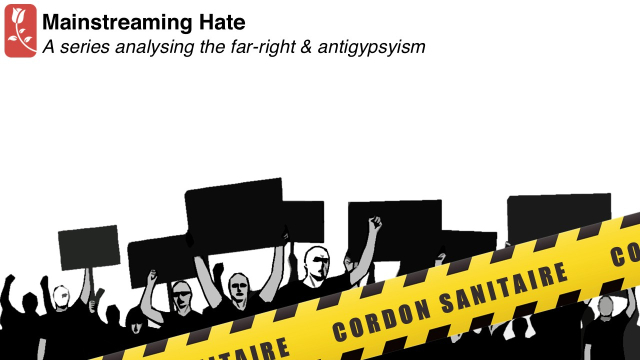
By the time of the European Court’s 2026 ruling against Bulgaria, twelve years after Simeonov's hate speeches in parliament, and almost four years after Meloni's dramatic electoral victory stunned Italy, the normalisation of far-right extremism continues apace across Europe. Despite the fall of Orbán in Hungary, far-right parties are either ruling, coalescing in government, or leading the polls in opposition in several EU member states. The cordon sanitaire that for decades united mainstream European parties against such collaboration with the far-right has been consigned to the past.
As the crumbling of the cordon sanitaire and the accommodation of far-right ideas by mainstream conservative parties in a number of EU member states accelerates, “a vicious cycle” kicks in, that according to the academic Tarik Abou-Chadi, doesn't bring the votes back, but does impact on norms and public opinion: "Accommodation normalises and legitimises far-right parties: voting for them is no longer a transgression. Second, opinion shifts: if mainstream parties say something is really important, people tend to believe it."
As opinion shifts further right on issues such as immigration and minority protections, the mainstream centre parties lurch ever rightwards, but rather than capture those votes, the process of accommodation merely results in their being 'cannibalised' by the far right.
Analysis shows that overall, far-right integration into the EU's political system is already well advanced and continues to grow. The member parties of the European Conservatives and Reformists (ECR), in particular, are now treated as normal political actors in many areas: in the European Council, in the Council of the EU, in the European Commission and as part of changing majorities in the European Parliament. This normalisation is down to the European People's Party (EPP), as is the extent of far-right influence, and the question which faction of the far-right will prevail within the EU system. In the long-term, according to Max Becker, this ought to present the EPP with a political dilemma:
"The EPP will have to decide whether and to what extent it wants to carry on playing its tactical game of utilising shifting majorities across the political spectrum. But if the EPP wants to remain loyal to the pro-European camp, it will have to abandon sooner or later its pursuit of an increasingly contradictory course of value-based positioning, on the one hand, and selective majority-building with far-right actors, on the other."
In the immediate term, the EPP has shown itself to be completely unbothered and unhindered by such ethical dilemmas, and as the folks at the Good Lobby have demonstratively shown, the EPP continues to rely on the far-right to pass legislation or secure short-term political wins. Their tracking of EPP votes alongside the far-right prompted the warning that:
“The EPP is not simply flirting with the far right – it has institutionalised a tactical alliance of convenience...These alliances may deliver short-term parliamentary wins. But the long-term price is immense: erosion of democratic safeguards, weakened climate ambition, compromised transparency, and a dangerous legitimisation of forces that thrive on division and exclusion.”
The Institutional Hollowing Out & Budget Risks Post—2028
The erosion of political norms described here finds a dangerous parallel in the structural weakening of the financial frameworks designed to protect marginalised communities. In their critical position paper regarding the European Union's long-term budget plan (Multiannual Financial Framework 'MFF' 2028–2034), the Fundación Secretariado Gitano (FSG) and the European Network on Roma Inclusion under EU Funds (EURoma) warn that the proposed budget architecture threatens to decouple EU funding from its social mission precisely as political support for Roma inclusion fragments.
The Commission propose integrating the European Social Fund (Europe's principal funding mechanism for investing in people) into broad National and Regional Partnership Plans. By dissolving dedicated structures for investing in human capital into larger, less transparent pots, the proposal risks diluting the specific focus on social inclusion. Without clear, ring-fenced funds for this purpose, Member States, many of which are now governed or influenced by parties accommodating far-right rhetoric against minorities, are likely to prioritise infrastructure and competitiveness over targeted interventions for the most disadvantaged groups. This shift effectively allows political accommodation of xenophobia to translate directly into fiscal neglect.
The stakes are very real. In Spain, the Fundación Secretariado Gitano currently operates its EqualTreatment Programme, funded by the European Social Fund Plus (ESF+), employing eleven Roma lawyers specialised in antigypsyism to defend victims of discrimination across the country. It stands as an innovative model of what dedicated ESF+ funding can deliver for Roma rights when it is ring-fenced and purpose directed. It is precisely this kind of targeted programme that the proposed dissolution of the ESF into generic Partnership Plans puts at risk.
Furthermore, the proposed framework marks a regression in accountability. Unlike previous programming periods, the post-2028 MFF largely confines references to Roma equality to non-binding recitals or limited performance indicators, removing the explicit objective on Roma inclusion that previously provided some small role as a safeguard. As FSG and EURoma emphasise, this "mainstreaming" without explicit targets ignores historical evidence that without mandatory recognition and measurable goals, Romani communities are likely to be systematically overlooked.
Compounding these risks is the introduction of provisions allowing unused social funds to be redirected toward "crisis response." In a geopolitical climate where far-right actors successfully frame migration and minority rights as security threats, this mechanism offers a ready pathway to defund anti-discrimination efforts under the guise of emergency management. Additionally, the reliance on short-term, performance-based metrics penalises the long-term, structural work required to combat antigypsyism.
The convergence of these trends creates a feedback loop: as the cordon sanitaire crumbles and mainstream parties normalise cooperation with far-right forces, the political will to defend specific Roma objectives diminishes. Simultaneously, the new MFF removes the bureaucratic and financial guardrails that could have forced investment regardless of political climate. As FSG and EURoma assert, unless the EU reinstates a specific Roma equality objective, guarantees a minimum allocation (proposing 25%) for vulnerable groups, and strictly enforces rule-of-law conditionality, the next decade of EU spending may inadvertently institutionalise the very inequalities that the far-right thrives upon.
This article is part of the ‘Mainstreaming Hate’ series, adapted exclusively from "The State of Hate: Antigypsyism & the Far-Right in Europe," a section of the Roma Rights Review: Summer 2026, published by the Roma Rights Network and the European Roma Rights Centre (ERRC). It is the third of a five-part series drawing on the Review's documentation of anti-Roma racism by state and non-state actors across Europe. The full Roma Rights Review is available here.
The second article was: “Disaster Nationalism in Action: Simeonov, Bulgaria, and the Mainstreaming of Hate Speech.”
Next in the series is: “Blurred Lines in Hungary: The 'Day of Honour', Far-Right Paramilitaries and Anti-Roma Racism.”