
Budapest: Nazis openly march in SS uniforms, while Holocaust survivor gets banned, and Romani Pride organiser gets prosecuted
19 February 2026
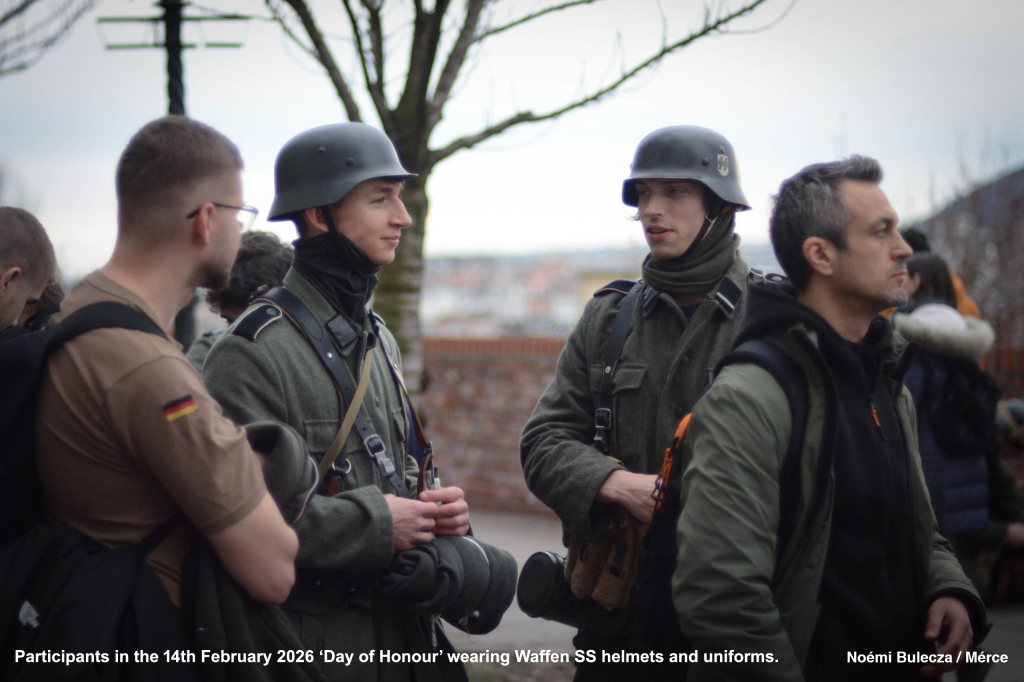
On Sunday 14th February, neo-Nazis converged on the Castle district in Budapest to commemorate what is known to the extreme right across Europe as the ‘Day of Honour’. This was the failed breakout attempt by 28,000 Nazi Waffen SS and Wehrmacht units, and their Hungarian allies, as the liberating Soviet army encircled Budapest in early 1945. Most were killed or captured, and Budapest was liberated a couple of days later on 13th February, bringing an end to not just to the 50-day siege of the city, but also a halt to the frenzied and murderous onslaught against the Jews of Budapest by Arrow Cross militias.
For the first time in years, there was no antifascist counter-demonstration. The police banned any such gatherings, citing the ‘antifa’ legislation passed last year. As reported by Mérce, one result of the law, was that Holocaust survivor Katalin Sommer was unable to deliver her planned speech at the Shoes on the Danube Bank Memorial. So, this year, while neo-Nazis were permitted to strut around the city in Arrow Cross and SS Uniforms and celebrate Hitler’s perpetrators, the Hungarian authorities denied Holocaust survivors and supporters the opportunity to bear witness and pay tribute to the victims of National Socialism.
What makes all of this especially obscene is the fact that the Városmajor site chosen by the Hungarian Legion to lay their wreaths in memory of ‘the fallen’ is mere yards away from the site of the atrocious massacre of patients and staff from the Jewish hospital in Maros utca. Between the 12th and 19th of January 1945, in the final days of the siege before the Soviets liberated Budapest, this neighbourhood witnessed some of the most barbaric atrocities by Arrow Cross militias. Under the command of the Catholic Franciscan monk, Father András Kuhn, the fascist militia launched raids against three Jewish health care institutions. The Arrow Cross slaughtered more than 300 mainly sick and elderly people while the Red Army was only a few blocks away.
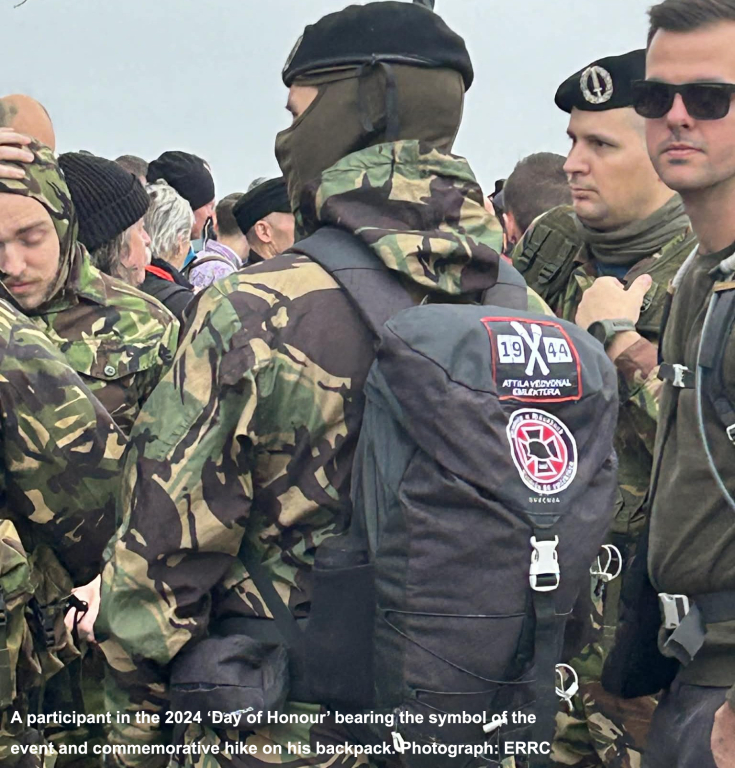
Smells like fascism: Fidesz hosting neo-Nazis while stamping on dissent
The staging of this overtly Nazi event, with a heavy police presence laid on by the authorities to protect the visitors from possible attacks by ‘antifa’, comes just days after the authorities filed criminal charges against Géza Buzás-Hábel, an activist of Romani origin, a teacher and human rights defender, for organising a peaceful LGBTQI+ rights march in Pécs. This case, as Amnesty noted, marks a troubling escalation in the criminalisation of LGBTQI+ expression and peaceful assembly in Hungary.
On the same day, 9th February, supporters gathered outside the Pest Central District Court for the preparatory session of the Methodist pastor Gábor Iványi's criminal trial. Charged with gang violence against a state official, Iványi told the court he would rather “accept a prison sentence than admit guilt” in what he considers a politically-motivated case ahead of Hungary’s parliamentary elections. Iványi, described by the Budapest mayor as “the living conscience of the city and the country,” has worked alongside and advocated for Roma, refugees, the poor and homeless. This trial is looking like a show trial.
On the 4th February, the Budapest Metropolitan Court announced its verdict in the ‘antifa case’ and sentenced non-binary German Maja T. to eight-years in prison, accused of taking part in an anti-fascist assault on neo-Nazis in Budapest for the 2023 ‘Day of Honour’. As we at the ERRC put it: “Make no mistake, this was a show trial. Maja’s extradition from Germany was illegal. The defendant was repeatedly led into court bound and shackled. The prosecution evidence was flimsy. And this entire travesty has been purely political, with the far-right regime calling for harsh sentences.”
What kind of country? Blurred lines between the regime and its friendly fascists
The lax and laissez-faire attitude of the Orbán regime to an overtly Nazi event which glorifies the SS and their Arrow Cross allies as heroes, comes as little surprise. The lead organiser of the Day of Honour is the ‘national resistance movement’, Légió Hungária, one in the cluster of far-right paramilitary groups adjacent to the extremist political party Mi Hazánk. Légió Hungária openly venerates historical fascist figures, engages in violent intimidation targeting the Roma, and maintains links to transnational neo-Nazi networks. For its part, Mi Hazánk, which won seven seats in the 2022 general election on a program which was a mish-mash of conspiracy theories, homophobia, and anti-migrant Islamophobia, is distinctive because of its obsessive anti-Roma racism. In its election posters and leaflets, they pledged to prevent Hungary becoming a ‘Gypsy country’, and stressed “the need to fight against all aspects of Gypsy delinquency” with voluntary self-defence associations.
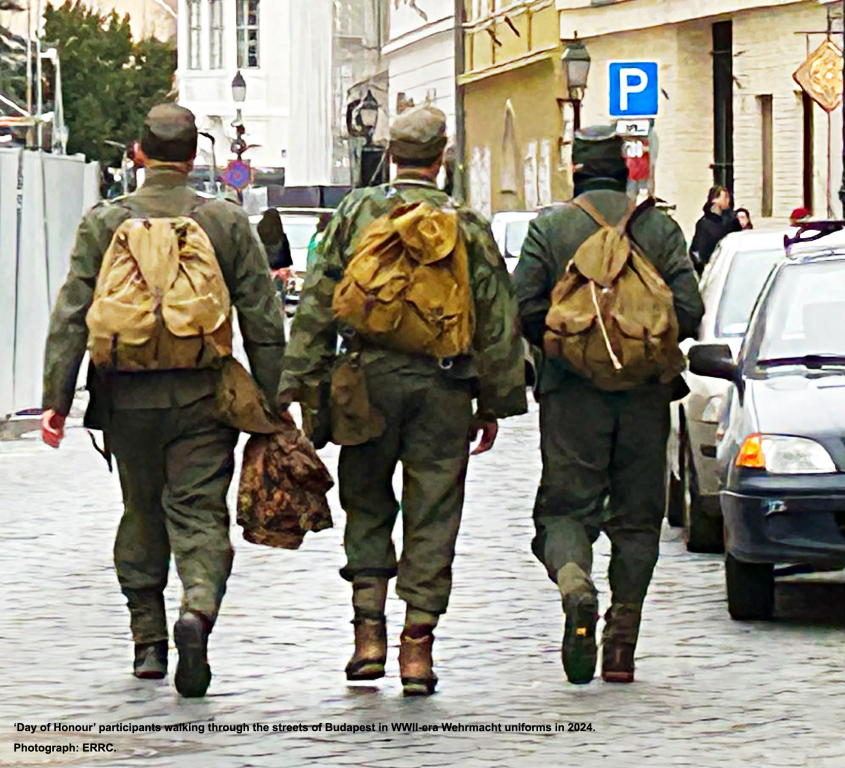
While Orbán speaks from what Fidesz calls a “cultural, civilisational standpoint” when being racist and regurgitating the ‘great replacement’ theory, to argue that Europeans should not become people of 'mixed race', and regularly blows racist dog whistles to his base about Roma, Mi Hazánk get down, local and specific. In their national version of the great replacement, the Mi Hazánk program noted that while the birth rate of Hungarians plummets,
“Gypsies are producing a population explosion typical of the Third World. The number of Gypsies doubles by generations, while the number of Hungarians is almost halved.”
The party called for the establishment of a ‘Family Planning Authority’, to reduce birth rates among Roma in those settlements that do not meet basic hygiene conditions and “still operate according to their own values, very different from those of northern civilization.” Since then, it has taken part in direct actions to intimidate Romani communities and its clarion call is to prevent Hungary becoming a Cigányország (a Gypsy country).
This party’s brand of extremism outstrips that of their Jobbik forebears, and marks them out as the most extreme far-right gang to take seats in the Budapest parliament since World War II. It functions as a friendly opposition party to Fidesz in the Hungarian parliament. As Political Capital put it:
“There is a symbiotic relationship between Fidesz, which aims to dominate the complete political field on the right, and the radical and far-right actors, the former taking topics and messages from the latter, viewing themselves as a driving force, as an actor channelling the society’s needs and steering the public discourse and the government towards the appropriate direction.”
The normalising of the ‘Day of Honour’, coupled with the criminalising of antifascist opposition, is part of a wider European malaise. The resurgence of anti-democratic forces, the cross-border networking of nationalist and authoritarian political parties, and the exchange of ‘best practices’ between political and militant extremists, has blurred the lines between nominally constitutional parties, street movements, and criminal paramilitary extremists. This annual ‘Day of Honour’ in Budapest provides a stark reminder that we are witnessing nothing less than the normalisation of fascism in 21st Century Europe.