
Drones, Dogs, and Dawn Raids: The Police War on Greece's Roma
25 May 2026
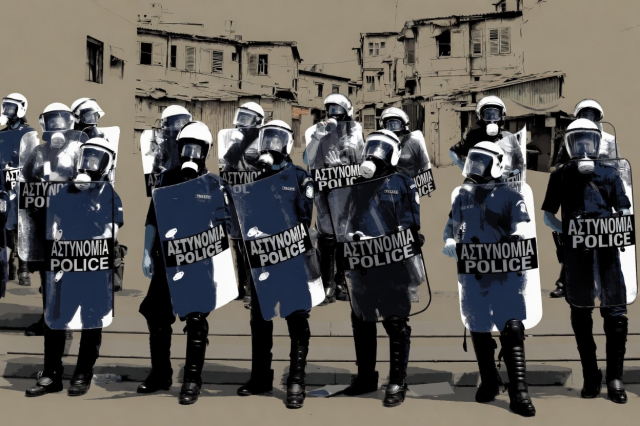
Before dawn breaks over the industrial outskirts of Greece’s towns and cities, police convoys begin moving toward Romani neighbourhoods. Tactical officers in black uniforms seal off roads, conduct house searches, deploy dogs and drones, and flood entire settlements with riot-gear equipped units. A few hours later, the operation appears online in the form of a sterile police press release: another “special intervention” against “criminality” in an area inhabited by “socially homogeneous groups.”
What the official statements rarely say explicitly is that the targets are unvaryingly Romani communities. The raids form part of Greece’s “ENTOS” (“from within”) operation, a coordinated policing campaign that may now constitute the largest sustained anti-Roma security operation in contemporary Europe.
The Scale of Operation ENTOS
Over the past several months, a systematic review of Hellenic Police (ELAS) press releases and local Greek-language reporting by the European Roma Rights Centre (ERRC) and the Greek Helsinki Monitor has revealed the scale of the anti-Roma police operation.
Despite mass police raids having been used as collective punishment on Romani communities for years, the turning point came in November 2025 when the Greek state broadcaster ERT reported the launch of a dedicated policing plan focused specifically on Roma-majority neighbourhoods. The report described an initiative involving intensified surveillance, expanded police presence, and targeted interventions in communities classified by authorities as "hotspots of illegality."
Since the official launch of the ENTOS operation in November 2025, 473 police officers have been mobilized across 152 localities in 25 areas of the country. The raids began in the months leading up to the announcement, upon which they intensified to the more than weekly occurrence seen today.
Between September 2025 and May 2026, at least 52 documented raids have been tracked by the ERRC and the Greek Helsinki Monitor. Most of these have occurred since April 2026, with near daily raids now occurring across Greece.
Although police language has remained formally neutral, activists and lawyers monitoring the operations say the increased activity and its implications were immediately obvious. What followed was not a series of isolated anti-crime interventions, but the emergence of a sustained policing model directed toward specific living areas long associated with Greece's Romani population.
The raids began appearing with increasing frequency on the ELAS website: coordinated operations in places such as Aspropyrgos, Zefyri, and Fyli in western Attica; repeated interventions in municipalities across Argolida, Corinthia, and Laconia; operations in communities near Thessaloniki, Lamia, and throughout Central Greece.
“After each ‘neutral’ police press release, scores of Greek media promptly report the news with the word ‘Roma’ added to the official release. It is an open secret that police send journalists an SMS to tell them that the most recent raid concerned Roma. The government wants positive public opinion and they do this by letting the public know that they are ‘combatting Roma criminality’,” said Panayote Dimitras from the Greek Helsinki Monitor.
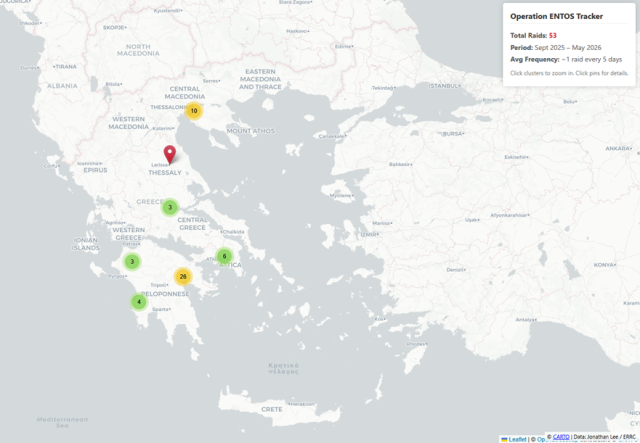
Click the map above to view the distribution of ENTOS police raids, or click here for the list of documented police raids.
The Bureaucracy of Euphemism
One of the most revealing aspects of the operations is the language authorities use to describe them. Several ELAS statements refer to interventions targeting "ομάδες κοινωνικής ομοιογένειας" ("socially homogeneous groups"), a phrase that appears repeatedly only in operations focused on localities known for being home to large Romani populations.
The wording functions as a kind of bureaucratic euphemism that is formally neutral while being practically unmistakable to the press. Police statements never refer directly to ethnicity, but local reporting frequently fills in the gap. In one operation in Fthiotida, police announced seven arrests during coordinated raids in "settlements" between 6th and 8th April 2026 without mentioning Romani communities at all. Local media covering the same operation reported the targeted neighbourhoods explicitly as Romani settlements.
The same dynamic repeats across the country. Police statements speak in abstract terms about "criminality," "prevention," and "security," while local reporting openly describes raids in Roma-majority areas. The result is a system in which ethnic targeting remains formally deniable while being operationally obvious.
The Disparity of Force
Perhaps the most striking feature of the ENTOS operations is the gap between the scale of the police deployments and the offences ultimately reported afterward. The operations themselves are frequently militarised. Tactical units participate alongside organised crime personnel. Entire neighbourhoods are subjected to saturation policing involving checkpoints, mass identity controls, home searches, and extensive stop-and-search operations. Surveillance drones and K-9 units are routinely deployed.
Yet the overwhelming majority of alleged offences concern relatively minor infractions linked directly to entrenched poverty and exclusion. The most common are irregular electricity connections, followed by administrative violations, traffic offences, identification document issues, and outstanding warrants.
In Zefyri, on 3rd May 2026, a large-scale heavily armed police deployment accompanied by motorcycle police and an unmanned aerial vehicle (UAV) resulted in 10 arrests for irregular electricity connections. On 7th May 2026, in Fyli, an operation framed by authorities as an intervention against generalised criminality ultimately resulted in two arrests related to excessive noise from a loudspeaker, possession of a wooden bat, and a small quantity of heroin. On 14th May, a raid in Aspropyrgos involving organised crime personnel, tactical units, a K-9 squad, and a UAV led to nine arrests for illegal electricity connections.
The contrast between the rhetoric of organised criminality and the operational outcomes is particularly visible in the way police and media emphasise the discovery of firearms.
In one April 2026 operation, authorities launched a major raid involving organised crime units, rapid-response tactical police (OPKE), motorcycle police officers (DIAS), and coordinated community-wide searches. Official statements announced 10 arrests and highlighted the seizure of hunting rifles alongside illegal electricity connections. Local coverage from Dimokratia amplified the imagery further, reporting the discovery of “weapons caches” belonging to “criminal groups of Roma.”
The actual findings described in the police statement were significantly less dramatic. The reported discoveries consisted of two hunting rifles allegedly recovered from one residence within an entire neighbourhood subjected to mass policing measures, one of which appeared visibly damaged with only the rifle stock remaining. There was no indication that authorities had dismantled a coordinated armed network or uncovered sophisticated organised criminal structures operating across the settlement as a whole.
This context matters because firearm possession in Greece, while regulated, is not itself exceptional. Hunting shotguns and inherited unregistered firearms remain relatively common in poorer and rural parts of the country, and estimates suggest that more than one million unregistered firearms circulate nationally. Illegal firearm possession therefore does not automatically indicate participation in organised criminal enterprises.
Yet in Roma-majority communities, isolated discoveries of unregistered hunting rifles are repeatedly used to justify settlement-wide operations involving tactical police, organised crime units, riot-equipped officers, drones, and large-scale searches.
A System of Collective Punishment
What emerges from the documented cases is not evidence of sprawling organised criminal networks embedded across entire settlements, but rather a policing model based on collective suspicion. Entire neighbourhoods are repeatedly subjected to raids because they are understood by authorities as inherently criminogenic spaces. Residents are not treated primarily as individuals under investigation for specific offences, but as populations inhabiting zones of permanent security concern. The operations themselves reinforce this logic. Low-level criminality associated with severe social exclusion is repeatedly uncovered, thereby retroactively validating the operation’s original premise. Human rights advocates monitoring the raids argue that the operations increasingly resemble a form of collective punishment directed at entire communities rather than targeted investigations into specific criminal activity.
The ENTOS initiative also allows for the recruitment of “special guards” from within Romani communities alongside the use of community “mediators” who assist police with information gathering. Critics argue that the strategy risks fracturing social cohesion by encouraging vulnerable residents to provide information on neighbours and relatives in exchange for cooperation with authorities.
The cumulative effects on residents are profound. Children witness tactical officers entering homes with dogs and assault weapons. Entire neighbourhoods experience repeated dawn incursions, mass identity checks, and constant surveillance regardless of individualised suspicion. Over time, policing ceases to function as an exceptional intervention linked to specific criminal investigations and instead becomes a recurring condition of everyday life.
Human rights advocates say this is precisely what distinguishes ENTOS from earlier police crackdowns on Romani communities in Greece. Previous operations were often reactive, linked to specific incidents or periods of media pressure. The newer model increasingly resembles a continuous security regime in which settlements are mapped, monitored, and repeatedly targeted through preventive policing operations justified by broad references to criminality.
Legal and Human Rights Concerns
Legal experts monitoring the operations argue that the pattern raises serious concerns under both Greek constitutional protections and European human rights law. Alexandra Karagianni, a Greek Romani human rights lawyer and member of the National Commission for Human Rights, said “this operational plan constitutes discriminatory policing against any principle of equal treatment and non discrimination. The practice [of mass raids] targets specific social groups aiming to control and intimidate the Romani population living under extreme poverty conditions rather than eliminate any criminality.”
The repeated concentration of mass police interventions in Roma-majority neighbourhoods, combined with the apparent absence of individualized suspicion, may constitute indirect ethnic profiling prohibited under Article 14 of the European Convention on Human Rights when read alongside protections concerning privacy, family life, and discrimination.
The ERRC and Greek Helsinki Monitor also point to the issue of proportionality. Operations involving heavily armed tactical units, drones, riot equipment, and organised crime personnel are repeatedly deployed to investigate offences such as irregular electricity connections, administrative violations, or minor drug possession. The resulting disparity between the level of force and the alleged offences has raised growing concern about the normalisation of exceptional policing measures in communities already subjected to longstanding discrimination and social exclusion.
“The results of the unjustified and frequent raids speak for themselves,” says Karagianni; “Minor criminal findings and a huge waste of public resources that could have been used for social policy measures.”
The International Blindspot
Despite the scale of the campaign, the raids have received remarkably little sustained international scrutiny. Unlike the mass evictions and camp demolitions that attracted criticism in France and Italy, or the racially targeted Code 100 policing operations documented in Slovakia, the Greek operations have remained largely invisible outside the country.
Part of the reason may be the language of organised crime and public security, which obscures the ethnic dimension of the operations themselves. Another factor is the limited institutional capacity among human rights organisations and independent monitors in Greece to systematically document the raids as they occur. Even compared to anti-Roma security measures elsewhere in Europe, including discriminatory legislation introduced in Slovenia and Italy, there has been comparatively little sustained international human rights coverage of ENTOS despite its scale and frequency.
A Legacy of Anti-Roma Violence
The ENTOS operation is the latest manifestation of a much longer history of state violence and discrimination against Roma in Greece. Since the 1990s, Greek authorities have repeatedly carried out “clean-up” operations involving forced evictions of Romani communities under the language of public order and crime prevention.
In recent years, several young Romani men have been killed during police pursuits and interventions. These include 18-year-old Nikos Sabanis, who was killed during a police chase in Perama in 2021 after officers fired dozens of rounds at the vehicle he was travelling in; 16-year-old Kostas Frangoulis, who was shot in the head in 2022 after allegedly leaving a petrol station without paying a €20 fuel bill; and 17-year-old Christos Michalopoulos, shot by police in 2023 after reportedly failing to stop at a checkpoint.
International institutions including the United Nations Committee on the Elimination of Racial Discrimination, the Council of Europe, and the European Court of Human Rights have repeatedly criticised Greece over discrimination against Romani communities and failures to address police violence and segregation. The ERRC and Greek activists argue that ENTOS represents a dangerous escalation by transforming longstanding patterns of ethnic profiling into a formalised and continuous policing strategy.
The Political Climate
The launch of ENTOS coincides with a broader political shift in Greece under the government of Kyriakos Mitsotakis and the governing New Democracy party, both of which have prioritised a law-and-order agenda centred on internal security. Government rhetoric surrounding migration, organised crime, and border enforcement has increasingly framed minority populations through the language of security threats and social disorder. In this environment, the boundaries between interior policing, preventive surveillance, and ethnic profiling have become increasingly blurred. ENTOS reflects this wider political logic.
Meanwhile the police themselves reveal the pattern of evidence against them. Every week, more convoys enter yet more neighbourhoods at dawn. Every week, more raids are announced via ELAS press releases, and each new raid deepens a system in which ethnicity is rarely named directly but remains impossible to miss.
The full list of known raids on Romani communities in Greece, compiled by the European Roma Rights Centre and its Roma Rights Network partner, the Greek Helsinki Monitor, is available here.